 by
Introduction
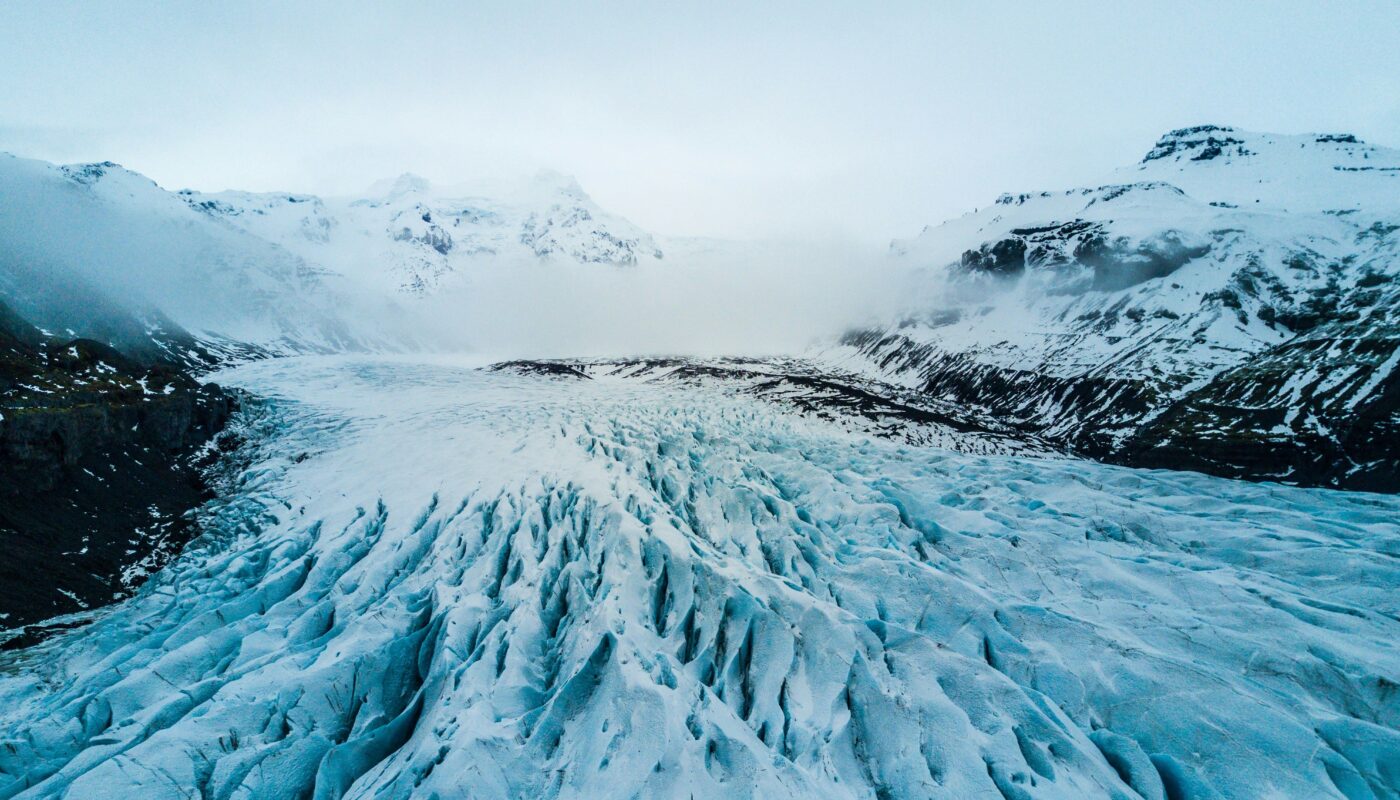
Glaciers are among the most impressive natural features on Earth. They cover large areas of polar regions and high mountain environments, forming enormous bodies of ice that can extend across valleys, mountain slopes, and entire landscapes. Although glaciers appear to be solid and permanent, they are constantly changing. They grow when snowfall accumulates and lose ice through melting, evaporation, and other processes.
But where does all this ice come from?
Every glacier begins with snow. In regions where temperatures remain sufficiently cold, snowfall can survive throughout the year without completely melting. When fresh snow falls over older layers, it gradually adds weight to the existing snowpack. Over time, the lower layers become compressed, their structure changes, and the spaces between individual snow grains become smaller.
Eventually, the snow transforms into a dense intermediate material called firn. With continued compression and the gradual elimination of connected air spaces, firn becomes glacier ice.
This transformation is known as the compaction process, and it is one of the most important stages in glacier formation. Although the basic principle is relatively simple, several physical changes take place beneath the surface. Snow crystals change shape, grains become connected, air is trapped in bubbles, and the material becomes increasingly dense.
Understanding this process helps scientists explain how glaciers develop and why different glaciers grow at different rates.
1. Every Glacier Begins with Snowfall
The formation of glacier ice starts in places where snow accumulates faster than it disappears.
These locations are commonly found in high mountain regions, polar environments, and areas with cold climates. Examples include the Himalayas, the Alps, Greenland, Antarctica, and parts of the Arctic.
When snow falls, it initially consists of individual ice crystals arranged in a loose structure. The shape of each snowflake depends on atmospheric temperature and moisture conditions during its formation.
Fresh snowfall contains a considerable amount of air between the crystals. This makes newly fallen snow relatively light and fluffy compared with the dense ice found inside an established glacier.
If temperatures remain low, the snow can survive beyond the season in which it fell. Additional snowfall then covers the older material.
This repeated accumulation creates layers of snow that gradually become thicker. As the upper layers grow, the weight pressing down on the lower layers increases.
However, not every snowy mountain becomes a glacier. For permanent ice to develop, the region must maintain a long-term balance in which enough snow survives each year to build up a lasting accumulation.
2. What Is Snow Compaction?
Snow compaction is the process through which loose snow becomes denser as the spaces between its grains decrease.
When fresh snow first settles on the ground, its crystals are loosely arranged. There are many small spaces between them, and these spaces contain air.
As new snowfall accumulates, the weight of the upper layers presses down on the older snow. The gaps between the individual grains shrink as they are reorganized.
Several physical changes occur during this process:
- Snow crystals move closer together.
- Individual grains become more tightly packed.
- The overall volume of the snow decreases.
- Air spaces become smaller.
- The density of the snow increases.
Compaction is not simply the crushing of snow under pressure. It also involves changes in crystal shape, the movement of water vapour, and the formation of connections between neighbouring grains.
Over time, these processes transform a loose collection of snow crystals into a much stronger and denser material.
3. The First Stage: Fresh Snow Accumulation
The first stage of glacier formation begins when snowfall collects on the ground and remains there for an extended period.
Fresh snow usually has a low density because its crystals contain large amounts of empty space. Its structure can change quickly after deposition.
The weight of newly fallen snow presses against the layers beneath it. Temperature fluctuations, wind, and the movement of water vapour can also influence the structure of the snowpack.
For example, wind can transport loose snow from exposed slopes and deposit it in sheltered locations. This can create deeper snow accumulations in certain areas.
The amount of snowfall is also important. Regions that receive substantial winter precipitation may develop thick snowpacks, provided that summer melting does not remove most of the accumulated material.
At this stage, the snow is still relatively soft and porous. It has not yet developed the dense structure associated with glacier ice.
4. The Second Stage: Snow Crystals Change Their Shape
After snowfall, the original snow crystals gradually begin to change.
This process is called snow metamorphism. It involves changes in the size, shape, and arrangement of snow grains.
Fresh snowflakes have delicate structures with branches and sharp features. Over time, these features become less pronounced as the crystals change through processes involving water vapour movement, temperature differences, and contact between grains.
In many snowpacks, individual crystals become rounded and more compact.
One important mechanism is the movement of water vapour from one part of the snowpack to another. Differences in temperature and vapour pressure can cause ice to evaporate from one surface and redeposit on another.
This process can change grain size and shape without requiring the entire snowpack to melt.
As the grains evolve, the snow becomes more tightly arranged and gradually develops a more stable structure.
Snow metamorphism is particularly important because it helps prepare the material for the later stages of densification.
5. The Third Stage: Increasing Pressure Compresses the Snow
As more snow accumulates, the pressure exerted by the upper layers increases.
The lower layers experience greater loading because they support the weight of everything deposited above them.
Under this pressure, snow grains move closer together. Their contact areas increase, and the structure becomes more compact.
The compression process is influenced by several factors:
Snow depth: Deeper snowpacks generally produce greater pressure on their lower layers.
Temperature: Warmer snow can deform and change structure more readily than extremely cold snow, although the details depend on the conditions.
Grain characteristics: The size, shape, and arrangement of snow grains influence how the material responds to pressure.
Time: Snow must remain under pressure long enough for the structural changes to develop.
As the snow becomes denser, its ability to hold air in large connected spaces decreases.
This stage is important because it moves the snowpack closer to the intermediate material known as firn.
6. The Fourth Stage: Snow Becomes Firn
One of the most important steps in glacier formation is the development of firn.
Firn is old snow that has survived at least one summer melting season and has undergone significant changes in density and structure. It is denser than fresh snow but has not yet become fully transformed into glacier ice.
The material may look grainy, coarse, and somewhat similar to compacted snow.
Unlike fresh snowfall, firn has experienced repeated cycles of accumulation, settling, and metamorphism. Its grains are generally larger and more closely connected.
The density of firn varies considerably, but it is commonly around 550–830 kilograms per cubic metre. Fresh snow can be much less dense, while pure glacier ice is typically close to 917 kilograms per cubic metre.
These figures are approximate because actual density depends on local environmental conditions and the stage of transformation.
Firn is particularly important in glacier science because it represents the transition between seasonal snow and solid glacier ice.
In many glaciers, the firn layer can extend across a substantial portion of the accumulation area.
7. The Fifth Stage: Air Spaces Become Smaller and More Isolated
Fresh snow contains many connected spaces filled with air. As the material becomes firn, these spaces gradually shrink.
Continued compression brings neighbouring ice grains closer together. The pore spaces become smaller, and the pathways through which air can move become increasingly restricted.
At first, air can still circulate through much of the porous snowpack. As densification continues, the pores become isolated from one another.
Eventually, many of these isolated spaces trap small quantities of air.
This is a major development in glacier formation because the material is becoming increasingly solid and less porous.
The remaining air becomes enclosed within tiny bubbles as the surrounding ice structure closes around it.
These trapped bubbles are especially valuable to scientists. They preserve samples of ancient atmosphere, allowing researchers to investigate past concentrations of gases such as carbon dioxide and methane.
The formation of these air bubbles is one reason glacier ice provides such an important record of Earth’s environmental history.
8. The Sixth Stage: Firn Transforms into Glacier Ice
With continued densification, firn gradually becomes glacier ice.
As the grains become more tightly connected, the remaining open spaces close off and the material develops a continuous ice structure.
The density approaches that of solid glacier ice, approximately 917 kilograms per cubic metre under typical conditions.
The transformation does not occur at exactly the same depth everywhere. It depends on temperature, accumulation rate, snow properties, and the amount of time available for compaction.
In colder regions, the process may take longer because the snow and firn remain at very low temperatures. In warmer accumulation areas, changes may happen more rapidly.
Once glacier ice forms, it can begin to deform under its own weight. If enough ice accumulates, gravity causes the glacier to move slowly downhill or outward from the area where the snow originally collected.
This movement distinguishes a glacier from an ordinary permanent snowfield.
9. How Does Temperature Influence the Compaction Process?
Temperature plays a major role in determining how quickly snow changes into glacier ice.
In extremely cold environments, snow crystals may remain relatively stable for long periods. The process of densification can be slow, especially when annual snowfall is limited.
In warmer glacier environments, snow grains may change more rapidly. Occasional melting and refreezing can also contribute to densification.
When snow melts, liquid water may move downward through the snowpack. If it reaches a colder layer, it can freeze again and form ice layers or ice lenses.
These layers may make parts of the snowpack denser.
However, melting and refreezing are not required for all glacier ice to form. In very cold environments, glacier ice can develop mainly through dry compaction, without significant liquid water movement.
This distinction is important when comparing glaciers in Antarctica with those found in warmer mountain regions.
10. Why Does the Accumulation Rate Matter?
The speed at which snow accumulates can strongly influence how quickly firn becomes glacier ice.
In areas with heavy annual snowfall, new layers build up rapidly. This increases pressure on older snow and can move the deeper material towards the ice stage more quickly.
In regions with limited snowfall, the process may take much longer because the snowpack grows slowly.
The accumulation rate also affects how long air remains connected to the atmosphere.
In areas with high snowfall, firn may become buried more rapidly. In locations with low accumulation, air can continue moving through the porous layers for longer.
This difference is important for interpreting ancient atmospheric records from ice cores.
Scientists must understand the history of accumulation and firn structure before using trapped air bubbles to estimate past atmospheric conditions.
11. The Role of Meltwater in Glacier Ice Formation
Although compaction is a central part of glacier formation, liquid water can also contribute to the transformation of snow into ice.
During warmer periods, some surface snow melts. The resulting water may travel downward through the snowpack.
If the water reaches a colder layer, it can freeze again. This process is known as refreezing.
Repeated melting and refreezing can produce dense ice layers within the snowpack.
These layers may develop into ice lenses or larger ice formations, depending on the amount of water and the surrounding temperature conditions.
This process is particularly common in some maritime and temperate glacier environments, where temperatures frequently approach the melting point.
However, the influence of meltwater varies between glaciers. In extremely cold regions, dry compaction is often more important than liquid-water refreezing.
12. How Scientists Study Snow Compaction and Firnification
Scientists use several methods to understand how snow transforms into glacier ice.
One important technique is drilling. Researchers extract samples from snow and firn layers to examine their structure, density, temperature, and trapped air.
These samples help scientists determine how the material changes with depth.
Another method involves measuring snow density. By collecting samples from different depths, researchers can observe how density increases within the snowpack.
Ground-penetrating radar is also useful. It allows scientists to investigate internal layers without removing large quantities of material.
Temperature sensors provide additional information about conditions inside the snow and firn.
Satellite observations can help scientists monitor changes in glacier surface elevation and snow accumulation over large areas, although they cannot directly reveal every detail of the compaction process.
Together, these methods help researchers understand how glaciers grow and how their internal structure responds to climate conditions.
13. Why the Compaction Process Matters for Climate Research
The transformation of snow into glacier ice is important for more than understanding how glaciers form. It also provides valuable information about Earth’s past climate.
As snow accumulates and becomes ice, tiny air bubbles can become trapped inside it. These bubbles preserve samples of the atmosphere from the time the ice formed.
Scientists can extract ice cores from glaciers and ice sheets to investigate historical concentrations of greenhouse gases.
Ice cores also contain information about past temperatures, snowfall, volcanic activity, and environmental changes.
Antarctica and Greenland are particularly important locations for this research because their ice sheets preserve records extending back hundreds of thousands of years.
The firn layer is especially significant because it controls how atmospheric air moves before becoming trapped in ice.
Understanding firn compaction helps scientists interpret ice-core records accurately and compare ancient atmospheric conditions with modern measurements.
14. What Happens When Snow Accumulation Becomes Greater Than Ice Loss?
A glacier grows when it receives more ice through snowfall and other accumulation processes than it loses through melting, evaporation, and the breaking away of ice.
The upper region where snow accumulates is called the accumulation zone.
The lower region, where ice loss is generally greater, is known as the ablation zone.
The boundary between these two areas is called the equilibrium line. At this elevation, annual accumulation and annual ice loss are approximately balanced.
When accumulation exceeds ablation over time, a glacier may gain mass and become thicker.
As the glacier becomes heavier, gravity causes the ice to deform and move. It may flow through a mountain valley or spread outward across a broad landscape.
If melting and other losses exceed accumulation, the glacier loses mass.
Therefore, snow compaction is the beginning of a much larger natural system involving snowfall, ice formation, glacier movement, and melting.
15. Can Climate Change Interrupt the Transformation of Snow into Glacier Ice?
Yes. Climate change can significantly affect the conditions required for glacier formation.
Rising temperatures may cause more snowfall to melt during warmer seasons. In some mountain regions, precipitation that previously fell as snow may increasingly arrive as rain.
This reduces the amount of material available to build the snowpack.
Warmer conditions can also increase meltwater production and change the structure of the firn layer.
In some locations, repeated refreezing may create thick ice layers within the snowpack. These layers can influence how future meltwater moves through the glacier.
If temperatures rise enough, the accumulation zone may shrink, and a glacier may lose more ice than it gains.
This does not mean that every glacier will disappear immediately. Different glaciers respond differently depending on elevation, snowfall, location, and local climate.
However, the long-term balance between snowfall accumulation and ice loss is becoming increasingly important as global temperatures rise.
Conclusion
The transformation of snow into glacier ice is a gradual process involving accumulation, crystal changes, compaction, firn formation, and the closure of air spaces.
It begins when snowfall remains on the ground beyond the season in which it fell. As additional layers accumulate, the weight of the upper snow compresses the material beneath. Snow grains change shape, become more closely connected, and gradually develop into firn.
With continued pressure and structural changes, the remaining pore spaces become smaller and eventually close. Air becomes trapped inside bubbles, and the firn develops into dense glacier ice.
This process can take many years or even centuries, depending on environmental conditions.
The science of snow compaction is essential for understanding glacier growth, movement, and climate history. It also helps researchers interpret ice cores and investigate how Earth’s atmosphere has changed over time.
Every glacier begins with individual snowflakes, but through the slow action of nature, those delicate crystals can become part of enormous frozen landscapes that influence rivers, ecosystems, sea levels, and the global climate.