 by
by Glaciers are among Earth’s most powerful and dynamic natural forces, sculpting mountains, carving valleys, and shaping entire ecosystems. While they may appear static and timeless, glaciers are in fact constantly in motion. Their movement, however, varies widely — from just a few inches per year to meters per day in rapid surge events. But why do glaciers move at all? And what determines how fast they travel?
In this deep dive, we’ll explore:
- How glaciers flow
- The factors that influence glacier speed
- The range of glacier movement from slow creep to surprising surges
- Real‑world examples of glacier motion
- How scientists measure glacier movement
- Why glacier speed matters in a changing climate
By the end of this guide, you’ll have a full understanding of one of nature’s great slow‑motion forces.
What Are Glaciers, Really?
Before we can measure glacier movement, it’s helpful to understand what glaciers are and how they behave.
A glacier is a large body of dense ice that forms where snow accumulates faster than it melts. Over time, this snow compacts, recrystallizes, and transforms into ice. Glaciers are found in polar regions like Antarctica and Greenland, as well as high mountain ranges such as the Himalayas, Alps, Rockies, and Andes.
Despite their icy stillness, glaciers flow under the influence of gravity — acting much like incredibly slow rivers of ice.
How Glaciers Move: Mechanisms of Ice Flow
Glacial movement isn’t random. It occurs through several distinct processes:
1. Internal Deformation
Inside the ice, especially deeper layers, pressure causes the ice crystals to deform and slide past one another. This internal deformation allows the glacier to slowly flow downhill even if the bedrock beneath is frozen.
2. Basal Sliding
Here’s where things get interesting: the base of a glacier can be lubricated by meltwater, reducing friction and allowing the glacier to slide over the bedrock. The presence of a thin layer of water at the glacier’s base acts like a natural glacier lubricant.
3. Subglacial Deformation
Sediments and soft materials beneath the glacier can deform under pressure, aiding glacier motion. This is especially common in areas where the glacier rests atop loosely packed sediments rather than solid bedrock.
4. Surge Events
In rare cases, some glaciers experience surges — periods of rapid motion far faster than their normal pace. These surges can send glaciers moving tens of meters per day, dramatically reshaping landscapes.
So How Fast Do Glaciers Move? The Spectrum of Speed
Glacier speed is typically measured in distance traveled per unit of time — for example, inches per year or meters per day. The speed varies widely depending on environment, topography, water presence, and glacier type.
Let’s explore the range of glacier movement from slowest to fastest:
🧊 Slow‑Moving Glaciers: Inches to Feet per Year
Many glaciers move extremely slowly, especially those in cold, dry regions where meltwater is minimal.
- Typical speed: a few inches to a few feet per year
- Common in: polar inland glaciers, cold continental ice sheets, and high mountain glaciers with frozen beds
In these cases, movement is dominated by internal deformation rather than basal sliding — which makes sense. With little liquid water at the base to lubricate motion, the glacier simply creeps forward under its own tremendous weight.
Some Antarctic glaciers fall into this category, moving just inches per year despite being vast in size.
❄️ Moderate Speed Glaciers: Feet to Meters per Year
Many mid‑latitude mountain glaciers fall into this category.
- Typical speed: tens to hundreds of feet per year
- Common in: Alaska, the European Alps, the Southern Alps of New Zealand
Here’s a real‑world example:
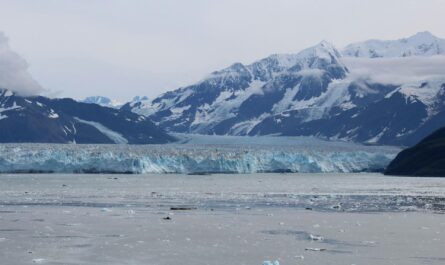
- Hubbard Glacier (Alaska) averages around 600–700 feet per year in typical conditions, though this can vary with temperature and meltwater availability.
These glaciers often combine internal deformation and basal sliding, with meltwater playing a key role in easing ice motion.
⚡ Fast Glaciers: Meters Per Day
Some of the most dramatic glacier motions occur in regions where basal lubrication is abundant, especially near coastal termini or in wet climates.
Under certain conditions, parts of a glacier can flow several meters per day — equivalent to over a kilometer per year.
Examples of fast glacier movement include:
- Surging glaciers
- Tidewater glaciers
- Glaciers with significant subglacial water systems
One striking case is Greenland’s outlet glaciers, many of which have been observed moving several meters each day.
These fast rates often occur during warm seasons, when meltwater is abundant and efficiently reaches the glacier’s base.
📈 Glacier Surges: Extreme Rapid Movement
Then there are the rare and dramatic glacier surges — events where a glacier temporarily accelerates to speeds that are multiples of its normal pace.
During surges:
- Some glaciers can move tens of meters per day
- Speeds of up to 100 meters per day have been recorded
Surges typically occur in cycles:
- A long period of slow buildup (decades)
- Followed by short, intense surge episodes (months to years)
Surging glaciers are found in places like:
- Alaska (e.g., Bering Glacier)
- Svalbard
- Yukon
These events are unpredictable and not directly tied to climate warming — they’re controlled by complex internal dynamics and water distribution beneath the glacier.
What Makes Some Glaciers Go Faster? Key Influencing Factors
If glaciers are all made of ice, why do some move slowly while others rocket forward?
Here are the main factors that control glacier speed:
❄️ 1. Temperature and Meltwater
Temperature isn’t just about warmth — it affects how much meltwater reaches the glacier base.
- Warmer summers create more meltwater.
- Meltwater acts as a lubricant, reducing friction at the glacier‑bed interface.
- More lubrication → faster basal sliding → faster glacier flow.
That’s why some glaciers speed up in summer and slow in winter.
💦 2. Subglacial Water Systems
The amount, pressure, and drainage patterns of water beneath a glacier dramatically influence speed.
Efficient drainage systems reduce friction and increase velocity, while poorly connected water systems can temporarily slow flow.
🌄 3. Bedrock Type and Roughness
The geology beneath a glacier matters:
- Smooth, sediment‑covered beds allow easier gliding.
- Rugged, jagged bedrock increases friction and slows motion.
Some glaciers sit on soft sediments, while others rest on hard crystalline rocks — and this difference changes how they move.
📐 4. Glacier Slope and Shape
Gravity is the engine of glacier motion — which means steeper slopes generally produce faster movement.
A glacier descending steep terrain tends to flow faster than one on a gentle gradient.
🌊 5. Presence of Icebergs and Tidewater Exposure
Coastal glaciers that end in the sea (tidewater glaciers) are influenced by:
- Water depth at the terminus
- Iceberg calving events
- Tidal cycles
These interactions can significantly accelerate glacier motion.
How Do Scientists Measure Glacier Movement?
Measuring glacier velocity may sound challenging — after all, these are remote and often hostile environments — but modern techniques are incredibly precise.
1. GPS Monitoring
Scientists place GPS sensors on ice surfaces. These track movement with centimeter‑level accuracy over time.
2. Satellite Remote Sensing
Satellites can measure:
- Ice displacement
- Surface deformation
- Ice velocity patterns across entire ice sheets
Satellites like Sentinel, Landsat, and RADAR interferometry systems are key tools.
3. Time‑Lapse Photography
Cameras set up over months or years capture visual progression — useful for valley glaciers and surging events.
4. Ground‑Based Radar & LIDAR
These techniques produce detailed ice surface maps and can reveal subtle motion beneath snow cover.
Examples of Glacier Movement Around the World
Here are some real‑world cases that illustrate the range of glacier speeds:
1. Jakobshavn Glacier (Greenland)
Often cited as one of the fastest glaciers on Earth:
- At times exceeding 10 meters per day
- Fueled by abundant meltwater and tidal interactions
Large icebergs calve regularly into the ocean.
2. Bering Glacier (Alaska)
A known surging glacier:
- Has exhibited sudden accelerations of several meters per day
- Surges tied to internal water redistribution and blockage cycles
3. Franz Josef Glacier (New Zealand)
A temperate glacier with dynamic flow:
- Can move up to 2–3 meters per day
- Meltwater heavily influences motion
Why Glacier Speed Matters
Understanding glacier movement is important not just for curiosity — it has real environmental and societal implications.
1. Sea Level Rise
Fast‑moving glaciers that discharge ice into the ocean contribute to sea level rise.
2. Water Resources
Glaciers feed freshwater rivers in many regions. Faster movement can change drainage patterns.
3. Natural Hazards
Rapid glacier movement can:
- Trigger ice avalanches
- Cause glacial lake outburst floods (GLOFs)
- Destabilize landscapes
4. Climate Feedbacks
Because glacier motion is sensitive to temperature and meltwater, changes in speed provide clues about warming trends.
Are Glaciers Speeding Up with Climate Change?
Yes — but it’s complicated.
In some regions such as Greenland and Antarctica, many outlet glaciers have accelerated measurably over recent decades, with greater meltwater production and ocean warming playing roles.
However:
- Not all glaciers behave the same
- Some slow down or stabilize because of changing mass balance
Overall, glacier speed is a dynamic indicator of environmental change, and tracking it provides scientists with critical insight into the global climate system.
Conclusion: From Inches per Year to Meters per Day
Glaciers are dynamic systems shaped by gravity, temperature, water, geology, and climate. Their movement spans a remarkable range:
| Glacier Type | Typical Speed |
|---|---|
| Cold continental glaciers | Inches per year |
| Mountain glaciers (moderate) | Feet to meters per year |
| Fast coastal glaciers | Meters per day |
| Surging glaciers | Tens of meters per day |
Despite their icy stillness, glaciers are never truly still. They are flowing rivers of ice, constantly reshaping the landscape and adapting to climatic forces. So the next time you stand at the edge of a glacier, remember — its motion is not frozen in time. It’s flowing, sliding, and evolving, inch by inch… meter by meter… year after year.