 by
by Ice avalanches are among the most dramatic and destructive natural phenomena found in high mountain regions. Unlike regular snow avalanches, which are triggered by accumulated snow, ice avalanches involve large masses of glacial ice that break off from steep slopes or glacier faces and plunge down valleys at astonishing speeds. These events pose serious risks to mountaineers, local communities, and infrastructure, and understanding their mechanisms is crucial for prediction, safety, and climate research.
This comprehensive article explores the formation, causes, dynamics, and consequences of ice avalanches, highlighting why they occur, how they can be predicted, and the impact they have on both natural landscapes and human activities.
What Is an Ice Avalanche?
An ice avalanche occurs when a mass of ice—often part of a glacier, hanging glacier, or icefall—detaches from a steep slope and rapidly descends due to gravity. These avalanches differ from snow avalanches in several key ways:
- Composition – Ice avalanches primarily consist of dense, compact glacial ice rather than loose snow.
- Volume – They can involve enormous masses, sometimes millions of cubic meters of ice.
- Speed – Ice avalanches can reach speeds exceeding 100 km/h (62 mph), making them highly destructive.
- Trigger Mechanisms – While snow avalanches are often triggered by weather or human activity, ice avalanches are influenced by glacial dynamics, temperature changes, and structural weaknesses in ice formations.
Ice avalanches are most common in high mountain ranges such as the Himalayas, Alps, Andes, and Rocky Mountains, often originating from hanging glaciers or glacier termini where ice overhangs a steep slope.
Formation of Ice Avalanches
Understanding how ice avalanches form requires examining glacier dynamics and ice mechanics. Glaciers are constantly moving due to the force of gravity acting on accumulated ice and snow. However, this movement is not uniform; some sections of a glacier are slower, while others are more active. These variations create stress points that can eventually lead to ice failure.
1. Hanging Glaciers
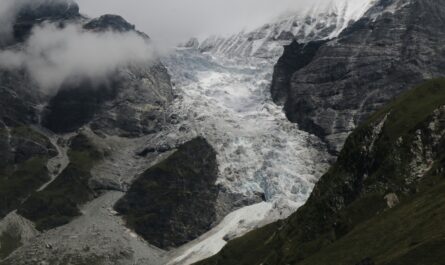
Hanging glaciers are small ice masses clinging to the sides of steep mountain cliffs. These formations are inherently unstable because:
- The ice is unsupported beneath.
- Internal stresses accumulate as the ice flows downward.
- Temperature fluctuations cause melting and refreezing, weakening ice cohesion.
When the stress exceeds the structural integrity of the ice, a portion can break off, resulting in an ice avalanche.
2. Glacier Terminus Collapse
The front of a glacier, known as the terminus, can also produce ice avalanches, especially when:
- Meltwater undermines the glacier base.
- Rapid retreat creates overhanging ice cliffs.
- Accumulated crevasses propagate through the ice.
Ice breaking off from the terminus can travel down valleys, often entraining debris and snow, increasing destructive potential.
Key Triggers of Ice Avalanches
Ice avalanches are influenced by a combination of natural factors, including:
1. Temperature Changes
- Rapid warming: During summer or heatwaves, surface melting weakens ice cohesion and lubricates the glacier base, facilitating detachment.
- Freeze-thaw cycles: Repeated melting and refreezing expand crevasses, creating stress fractures.
2. Glacier Movement
Glacial flow generates internal stress. Sections of ice moving at different speeds create tension that can lead to sudden ice collapse.
3. Seismic Activity
Earthquakes, even minor ones, can destabilize hanging glaciers or ice cliffs. Even small tremors can trigger large avalanches by breaking pre-existing fractures.
4. Avalanches Above Ice Masses
Snow avalanches can sometimes trigger ice avalanches. The additional weight or impact of falling snow destabilizes an ice mass.
5. Water Infiltration
Meltwater from precipitation or glacier surface melting can seep into cracks, reducing friction and increasing hydrostatic pressure. This phenomenon is particularly common in warmer climates or during unusually wet seasons.
Dynamics of Ice Avalanches
Once an ice avalanche initiates, several physical processes dictate its behavior:
1. Acceleration and Flow
Gravity pulls the ice downward, often along steep, confined valleys. The flow can involve:
- Ice chunks and seracs breaking apart mid-descent.
- Debris entrainment, where rocks, snow, and soil mix with ice.
- Impact waves, producing shock forces that amplify destruction.
2. Momentum and Runout Distance
Ice avalanches can travel large distances depending on slope, ice volume, and valley configuration. Some documented events have reached several kilometers from their source, destroying everything in their path.
3. Secondary Hazards
Ice avalanches often generate secondary hazards such as:
- Ice jams in rivers, causing floods.
- Debris flows, mixing ice with soil and rocks.
- Avalanche-triggered snow slides, increasing mass and momentum.
Notable Ice Avalanche Events
Studying past events provides insight into the scale and risk of ice avalanches:
- Himalayan Ice Avalanche, 2013 – A hanging glacier collapse in the Kedarnath region of India triggered massive flooding, destroying infrastructure and claiming hundreds of lives.
- Alaskan Ice Avalanches – In Alaska’s Chugach Mountains, ice avalanches frequently occur from hanging glaciers, occasionally impacting local ski areas and infrastructure.
- Alps, Switzerland – The European Alps experience smaller-scale ice avalanches, often from glacier termini in summer. These events rarely cause fatalities but can damage roads or property.
These examples demonstrate the global distribution and varying scales of ice avalanche hazards.
Predicting Ice Avalanches
Forecasting ice avalanches remains a challenge due to the complex interplay of factors. Nevertheless, advancements in monitoring and technology have improved predictive capabilities:
1. Remote Sensing
- Satellite imagery detects crevasse propagation and glacier retreat.
- LiDAR and photogrammetry measure glacier deformation and potential collapse zones.
2. Temperature and Weather Monitoring
Rapid temperature changes, heavy rain, or sudden heatwaves can indicate heightened risk. Continuous monitoring allows authorities to issue warnings.
3. Seismic Sensors
Seismic networks detect micro-tremors and movements within glaciers that may precede large collapses.
4. Modeling Glacier Mechanics
Advanced computer models simulate glacier flow, stress accumulation, and ice stability. These models provide hazard maps and identify high-risk areas for climbers, communities, and infrastructure planning.
Safety and Risk Mitigation
For mountaineers, hikers, and residents near glaciers, awareness and preparation are essential. Measures include:
- Avoiding Icefall Zones – Steep hanging glaciers and overhanging ice cliffs are high-risk areas.
- Timing Visits – Early morning or colder periods reduce the risk of ice loosening due to melting.
- Following Expert Guidance – Local guides are familiar with seasonal hazards and safe routes.
- Monitoring Warnings – Regional avalanche forecasts and glacial hazard reports provide critical safety information.
- Protective Infrastructure – In some high-risk communities, barriers or diversion channels are constructed to mitigate ice and debris flow impact.
The Role of Climate Change
Climate change is intensifying the frequency and severity of ice avalanches:
- Rising Temperatures – Warmer summers accelerate melting, increasing glacier instability.
- Glacial Retreat – As glaciers shrink, overhanging ice cliffs become more prominent and prone to collapse.
- Changing Precipitation Patterns – Increased rainfall contributes to hydrostatic pressure in ice fractures.
Recent studies indicate that the Himalayas, European Alps, and Andes are all experiencing a growing number of ice avalanches directly linked to warming trends. For communities and mountaineers, this underscores the urgency of monitoring and adapting to evolving glacial hazards.
Conclusion
Ice avalanches are a powerful reminder of the dynamic forces at work in high mountain environments. They result from a combination of gravity, glacial movement, temperature fluctuations, seismic activity, and water infiltration. The consequences can be catastrophic, impacting natural landscapes, human infrastructure, and even climate research stations.
Understanding the formation, triggers, and behavior of ice avalanches allows scientists to predict risks more accurately, informs safety guidelines for climbers and local communities, and emphasizes the broader impacts of climate change on glacial systems. While these events are awe-inspiring in their scale and force, they also highlight the delicate balance between human activity and the unpredictable power of nature.
For adventurers, researchers, and policymakers, the study of ice avalanches is not just about fascination—it is a matter of safety, preparedness, and respect for the icy giants that shape the world’s high mountains.