 by
by Glaciers are often imagined as giant frozen rivers made entirely of solid ice. From a distance, they appear dense, compact, and almost rock-like in their immense weight and permanence. Towering glacier walls, deep blue ice caves, and vast frozen landscapes give the impression of something completely solid and impenetrable. Yet glaciers are far more complex than simple blocks of frozen water.
One of the most fascinating questions about glaciers is whether they are truly solid or whether they contain air trapped inside them. The answer is surprisingly interesting because glaciers are both solid and full of air at different stages of their formation. In fact, the presence of trapped air inside glaciers is one of the reasons scientists can study ancient climates, atmospheric history, and environmental changes stretching back hundreds of thousands of years.
Understanding how glaciers form, compress, and evolve helps explain why glacier ice behaves differently from ordinary ice cubes in a freezer. It also reveals how glaciers preserve tiny bubbles of ancient air like frozen time capsules hidden within the ice.
To fully answer this question, it is important to explore how glaciers form, how snow transforms into ice, why air becomes trapped, and how glacier structure changes over time.
How Glaciers Begin
Glaciers begin as snow.
In cold regions where snowfall accumulates faster than it melts, layers of snow gradually build year after year. This process usually occurs in:
- Polar regions
- High mountain ranges
- Arctic environments
- Antarctic ice sheets
Fresh snow contains enormous amounts of air between its delicate ice crystals. Newly fallen snow is actually quite porous, meaning it has many tiny open spaces filled with air.
This is why fresh snow feels light and fluffy rather than hard and compact.
Over time, additional snowfall presses down on older layers beneath it. The increasing weight slowly compresses the snow, beginning the transformation into glacier ice.
The Transition From Snow to Firn
As snow becomes buried under newer layers, it starts changing physically.
The snowflakes lose their delicate shapes and become compressed into denser grains called firn. Firn is an intermediate stage between snow and glacier ice.
At this point:
- Air spaces shrink
- Snow becomes denser
- Ice crystals grow larger
- Compression increases
Firn has many interconnecting air passageways despite being denser than fresh snow.
This stage can last years or even decades depending on climate conditions and snowfall rates.
Eventually, continued pressure compresses the firn even further, transforming it into glacier ice.
How Air Becomes Trapped Inside Glaciers
As firn compresses into dense ice, many of the open air channels close completely.
When this happens, tiny pockets of air become sealed inside the ice as bubbles.
These trapped bubbles are one of the defining characteristics of glacier ice.
So, glaciers are not completely solid in the purest sense. Instead, they contain countless microscopic air bubbles trapped during the ice formation process.
These bubbles are incredibly important because they preserve samples of ancient atmospheres from the time the snow originally fell.
Some glacier ice contains air trapped tens of thousands—or even hundreds of thousands—of years ago.
Why Glacier Ice Looks Blue
The structure of glacier ice affects how light moves through it.
Fresh snow appears white because its loose crystals scatter light in many directions. Glacier ice, however, becomes much denser through compression.
As air spaces shrink and ice crystals compact together:
- More light penetrates the ice
- Red wavelengths are absorbed
- Blue wavelengths travel deeper
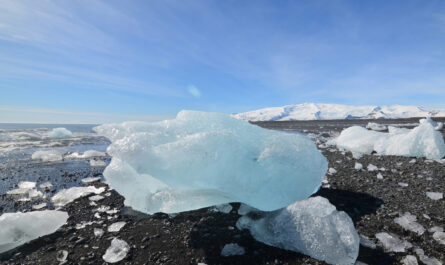
This is why dense glacier ice often appears brilliantly blue.
Interestingly, glacier ice with fewer air bubbles often appears clearer and more intensely blue than younger, less compacted ice.
Are Glaciers Mostly Ice or Mostly Air?
Although glaciers contain trapped air, they are still primarily made of solid ice.
The amount of air changes depending on:
- Glacier age
- Compression level
- Depth within the glacier
- Temperature conditions
Fresh snow may contain more air than solid material. But as snow transforms into glacier ice, the proportion shifts dramatically toward dense ice.
Deep glacier ice can become extremely compact, with relatively small amounts of trapped air remaining.
Even so, tiny air bubbles continue existing throughout much of the glacier structure.
Why Trapped Air Matters to Scientists
The trapped air bubbles inside glaciers are among the most valuable scientific records on Earth.
Scientists drill deep ice cores from glaciers and ice sheets to study ancient atmospheres.
Each layer of ice preserves tiny samples of air from the time the snow originally fell.
By analyzing these bubbles, researchers can measure:
- Ancient carbon dioxide levels
- Methane concentrations
- Atmospheric composition
- Volcanic activity
- Climate patterns
- Pollution history
Ice cores from Antarctica and Greenland have revealed climate records stretching back hundreds of thousands of years.
Without trapped air bubbles, scientists would know far less about Earth’s environmental history.
Glaciers Are Not Completely Rigid
Another surprising fact is that glaciers are not fully rigid solid masses.
Although glacier ice is solid, glaciers slowly flow and deform over time under their own enormous weight.
This movement occurs because:
- Ice crystals shift gradually
- Pressure causes deformation
- Meltwater lubricates glacier bases
- Gravity pulls glaciers downhill
Glaciers therefore behave somewhat like extremely slow-moving rivers.
Some glaciers move only a few centimeters per day, while others may move several meters daily.
This flowing behavior further demonstrates that glaciers are dynamic systems rather than static frozen blocks.
The Difference Between Glacier Ice and Regular Ice
Glacier ice differs significantly from ordinary ice found in freezers or household ice cubes.
Regular Ice
Household ice forms quickly when liquid water freezes.
It usually contains:
- Random air pockets
- Cracks
- Cloudy sections
- Uneven crystal structures
Glacier Ice
Glacier ice forms over many years through intense pressure and compression.
As a result, it often becomes:
- Denser
- More compact
- More transparent
- Structurally layered
- Rich in compressed ancient air bubbles
This slow formation process gives glacier ice unique visual and physical properties.
Why Glacier Ice Sometimes Crackles
If glacier ice melts in water or drinks, it sometimes creates crackling or popping sounds.
These noises happen because ancient compressed air bubbles suddenly escape as the ice melts.
The bubbles may have remained trapped inside the glacier for thousands of years before being released.
This phenomenon provides direct evidence that glacier ice contains air rather than being completely solid.
Air Bubbles Change With Glacier Depth
The deeper scientists drill into glaciers, the more ice pressure increases.
At great depths:
- Air bubbles become smaller
- Pressure rises dramatically
- Ice structure becomes denser
In some very deep ice layers, pressure can become so intense that air bubbles deform into clathrates—crystal structures where gas molecules become trapped within ice lattices.
These conditions occur deep within massive polar ice sheets.
Do All Glaciers Contain Air?
Most glaciers contain trapped air bubbles, but the amount varies.
Factors influencing air content include:
- Snow accumulation rate
- Temperature
- Ice age
- Glacier thickness
- Compression history
Some older glacier ice may contain fewer visible air pockets because of extreme compression.
Newer glacier ice closer to the surface generally contains more noticeable bubbles.
How Glacier Air Helps Climate Research
Ice core research has transformed climate science.
By studying trapped glacier air, scientists discovered connections between:
- Greenhouse gases
- Global temperatures
- Ice ages
- Human industrial activity
For example, researchers can compare modern atmospheric carbon dioxide levels with ancient samples trapped in glacier ice.
This allows scientists to understand how dramatically Earth’s atmosphere has changed over time.
Glaciers therefore act as natural climate archives preserving environmental information far older than written human history.
Glacier Ice Can Contain Other Materials Too
Air is not the only thing trapped inside glaciers.
Glacier ice may also contain:
- Dust
- Ash from volcanic eruptions
- Pollen
- Pollution particles
- Microorganisms
- Tiny rocks
These materials become buried within snowfall layers over time.
Scientists use these trapped substances to study ancient ecosystems, volcanic events, and atmospheric circulation patterns.
Why Glacier Structure Matters
Understanding glacier structure helps scientists predict:
- Glacier movement
- Melting rates
- Ice stability
- Climate interactions
- Sea-level rise
The balance between solid ice, trapped air, temperature, and pressure affects how glaciers respond to warming climates.
Air pockets can influence:
- Ice density
- Light absorption
- Melting behavior
- Internal pressure systems
Although glaciers may appear simple from the outside, they are remarkably complex physical systems.
What Happens as Glaciers Melt?
As glaciers melt due to rising temperatures:
- Ancient air bubbles are released
- Meltwater forms
- Glacier structure weakens
- Ice density changes
Scientists are particularly concerned because shrinking glaciers mean losing valuable climate records preserved in ancient ice.
Once glacier ice melts, the environmental history trapped inside it disappears permanently.
Common Misconceptions About Glaciers
Many people assume glaciers are:
- Completely solid
- Motionless
- Uniform throughout
- Simple frozen water masses
In reality, glaciers are:
- Dynamic
- Layered
- Slowly moving
- Structurally complex
- Full of trapped atmospheric history
Their combination of solid ice and preserved air makes them scientifically extraordinary.
Why Glaciers Matter Beyond Beauty
Glaciers are not only visually impressive landscapes. They are essential parts of Earth’s environmental systems.
They influence:
- Sea levels
- Water supplies
- Ocean circulation
- Climate regulation
- Ecosystems
The trapped air inside glaciers also allows humanity to study environmental conditions long before modern instruments existed.
Without glaciers, our understanding of Earth’s climate history would be far more limited.
Final Thoughts
So, are glaciers solid or full of air?
The answer is both.
Glaciers are primarily made of dense solid ice, but they also contain countless tiny air bubbles trapped during the gradual transformation from snow into compressed glacier ice. These bubbles are far more than simple pockets of air—they are frozen records of ancient atmospheres preserved over thousands or even hundreds of thousands of years.
As snow accumulates and compresses over time, glaciers become denser and more solid, yet small amounts of trapped air remain locked inside the ice. These air bubbles help scientists study Earth’s climate history, atmospheric changes, and environmental evolution in remarkable detail.
Far from being simple frozen masses, glaciers are dynamic, complex systems filled with scientific information, geological history, and environmental significance. Understanding their structure reveals not only how glaciers form but also why they remain some of the most important natural archives on the planet.