 by
by At the southern edge of South America lies one of the most extraordinary ice landscapes on the planet—Patagonia’s glaciers. Spread across Chile and Argentina, this vast frozen wilderness is a place where towering ice formations meet rugged mountains, deep blue lakes, and powerful winds. It is a region where nature still dominates, and where glaciers continue to shape the land in real time.
Unlike the frozen extremes of the Arctic or Antarctica, Patagonia’s glaciers exist in a dynamic environment where ice, forest, ocean, and mountain collide. This makes the region not only visually stunning but also geologically active and constantly changing.
This article explores how these glaciers formed, where they are located, what makes them unique, how travelers experience them, and why they are becoming increasingly important in a changing global climate.
The Frozen Backbone of Patagonia
Patagonia is divided between southern Chile and Argentina, forming one of the most remote and dramatic regions in the world. Within this vast area lie two major ice systems:
- The Northern Patagonian Ice Field
- The Southern Patagonian Ice Field
These ice fields are among the largest reserves of freshwater ice outside the polar regions. Together, they feed dozens of glaciers that flow outward through valleys, mountains, and fjords.
What makes this region especially remarkable is that these glaciers are not isolated features—they are part of a connected system that actively shapes the geography of southern South America.
How Patagonia’s Glaciers Are Formed
Glaciers begin with snow accumulation that never fully melts. Snow layers eventually compress to form dense ice. Under the force of gravity, this ice slowly begins to move downhill.
In Patagonia, this process is supported by:
- Heavy snowfall in the Andes Mountains
- Cold temperatures at high elevations
- Steep valleys that guide ice flow
As glaciers move, they reshape the landscape beneath them. They carve valleys, deepen lakes, and transport rock and sediment over long distances. Eventually, parts of the glacier may break off in a dramatic process known as calving, especially where ice meets water.
Although the movement is slow—often only a few meters per day—the long-term impact is enormous.
Chilean Patagonia: Where Ice Meets Ocean
On the Chilean side of Patagonia, glaciers create one of the most dramatic natural scenes on Earth. Here, ice often flows directly into fjords and ocean channels, forming a striking contrast between frozen and marine environments.
Key Chilean Glacier Areas
- Torres del Paine region
- Laguna San Rafael National Park
- Sections of the Patagonian Ice Fields
One of the most well-known glaciers in this region is Grey Glacier, which can be seen from trekking routes and boat excursions.
What makes Chilean Patagonia unique is the combination of ecosystems in a single view: glaciers, temperate rainforests, rivers, and ocean waters all exist side by side. This creates a constantly changing and visually rich environment.
Argentine Patagonia: Iconic Ice Landscapes
On the Argentine side, Patagonia is home to some of the most famous and accessible glaciers in the world.
Major Glacier Highlights
- Perito Moreno Glacier
- Upsala Glacier
- Viedma Glacier
- Los Glaciares National Park
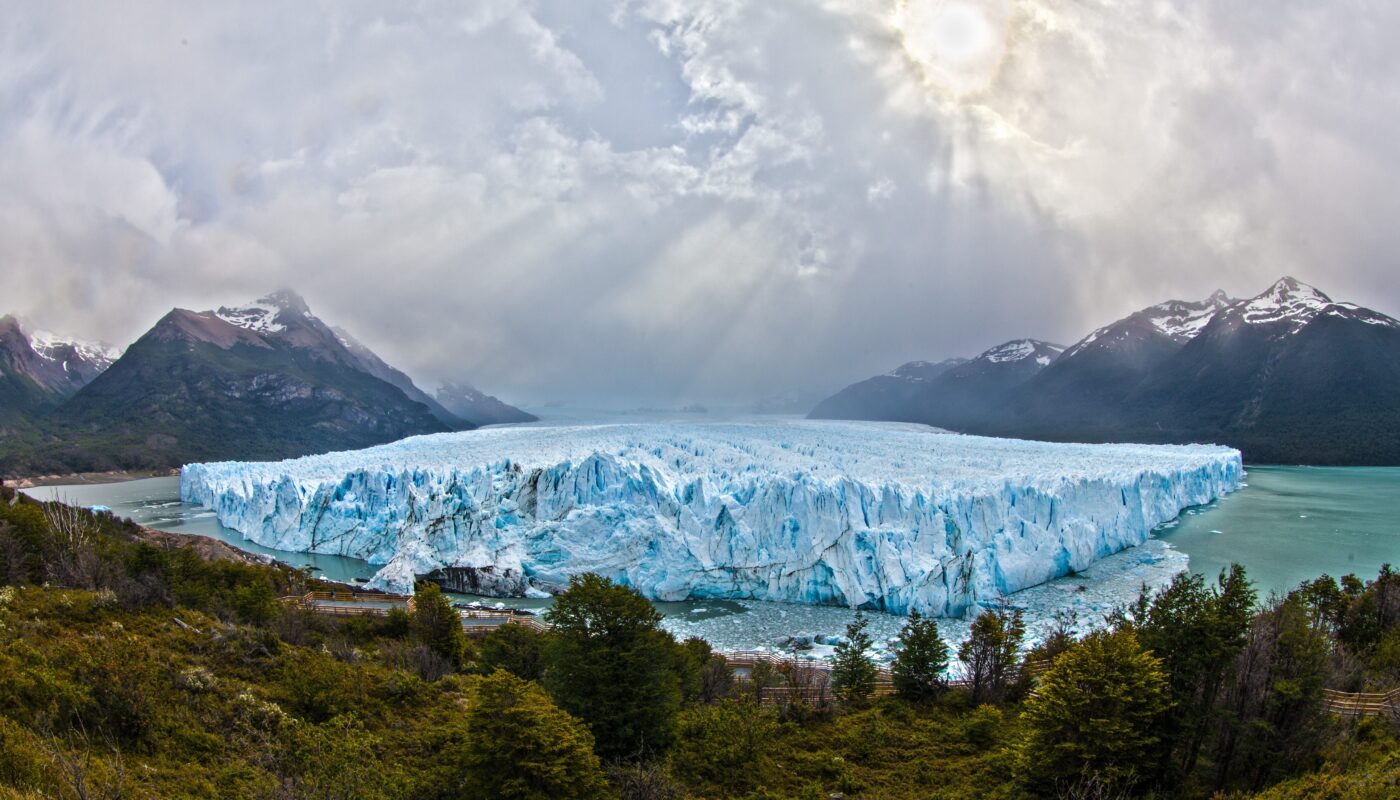
Among these, Perito Moreno is the most iconic. It is widely known for its dramatic ice collapses, where large sections of the glacier break off and crash into Lake Argentino with powerful sound and motion.
Unlike many glaciers worldwide that are rapidly shrinking, Perito Moreno has remained relatively stable in recent decades, making it a rare exception. However, scientists continue to monitor it closely as climate conditions evolve.
Visitors can observe it from extensive walkways or approach it via boat tours, allowing for close-up views of its towering ice walls.
A Living and Moving Ice System
One of the most fascinating aspects of Patagonia’s glaciers is that they are constantly moving. They are not static blocks of ice but flowing systems influenced by gravity and temperature.
Visitors often notice that glaciers:
- Crack and shift unexpectedly
- Produce loud booming sounds during ice breaks
- Release chunks of ice into surrounding lakes or fjords
These natural sounds and movements serve as reminders that glaciers are dynamic systems, not frozen sculptures. They respond continuously to environmental conditions.
Wildlife Around the Glaciers
Despite the extreme conditions, Patagonia’s glaciers are surrounded by diverse wildlife and ecosystems.
In surrounding areas, it is possible to find:
- Guanacos grazing in open valleys
- Condors flying above cliffs
- Foxes and other adapted mammals
- Cold-resistant vegetation in lower regions
Meltwater from glaciers also feeds rivers and lakes, supporting plant and animal life far beyond the ice fields themselves.
This makes glaciers essential not just for scenery, but for the survival of entire ecosystems.
Adventure Tourism in Glacier Country
Patagonia has become a global destination for adventure tourism, offering travelers the chance to experience glaciers up close.
Popular activities include:
- Guided glacier trekking with crampons
- Ice climbing on frozen surfaces
- Kayaking among floating icebergs
- Boat tours along glacier fronts
- Multi-day hiking routes through national parks
These experiences allow visitors to interact directly with ancient ice formations in a safe and guided environment.
Walking on a glacier often feels otherworldly—surrounded by deep blue ice formations, crevasses, and frozen landscapes that stretch far into the distance.
Climate Change and Glacial Retreat
One of the most important issues facing Patagonia today is the gradual retreat of many glaciers. As global temperatures rise, ice loss has become increasingly noticeable in several areas.
Current observations show:
- Many glaciers are shrinking in size
- Ice flow patterns are changing
- Smaller glaciers are disappearing entirely
- Melt rates are accelerating in recent decades
This has serious consequences, including:
- Changes in freshwater availability
- Rising sea levels
- Altered ecosystems
- Impacts on tourism and local economies
Because glaciers respond quickly to temperature shifts, they are often used by scientists as indicators of climate change.
In some regions, environmental debates have also focused on how to balance conservation with economic development, especially where mining or infrastructure projects overlap with protected glacier zones.
Why Patagonia’s Glaciers Matter Globally
Patagonia’s glaciers are not just regional landmarks—they play a significant role in global environmental systems.
They:
- Store large amounts of freshwater
- Reflect sunlight and influence temperature regulation
- Contribute meltwater to rivers and oceans
- Provide long-term climate data through ice layers
Each glacier acts like a natural record of past climate conditions, preserving information about snowfall, temperature, and atmospheric changes over thousands of years.
This makes them extremely valuable for scientific research.
Experiencing the Glacier Wilderness
Travelers who visit Patagonia often describe the experience as overwhelming in scale. Photographs rarely capture the true size and presence of the glaciers.
Common impressions include:
- A deep sense of silence interrupted by ice movement
- Awareness of immense geological time
- Contrasts between fragile human presence and massive natural forces
- Emotional reactions to the beauty and power of the landscape
Whether seen from a hiking trail, a boat deck, or a distant viewpoint, the glaciers leave a lasting impact on visitors.
Final Thoughts
The glaciers of Patagonia represent one of the most remarkable natural environments on Earth. Stretching across Chile and Argentina, they form a vast frozen system where ice, mountains, forests, and water constantly interact.
They are powerful, beautiful, and essential to regional ecosystems—but also increasingly vulnerable to global climate change.
For travelers, they offer rare opportunities to witness living ice landscapes up close. For scientists, they provide critical insight into environmental shifts. And for the planet, they serve as a reminder of how dynamic and interconnected Earth’s systems truly are.
Patagonia’s glaciers are not frozen in time—they are constantly changing, shaping the land, and telling the story of a planet in motion.