 by
by Glaciers are among the most powerful and mysterious natural formations on Earth. They look calm and still from the surface, yet they are constantly moving, reshaping mountains, carving valleys, and storing vast amounts of the planet’s freshwater. One of the most fascinating questions scientists and travelers often ask is: how deep are glaciers, and what actually lies beneath all that ice?
The answer is far more complex than a single number. Glacier depth varies dramatically depending on location, climate, and geography. Some glaciers are relatively shallow, while others contain ice more than a kilometer thick, hiding entire landscapes beneath them.
To understand glaciers, we need to look not just at how deep they are, but also at what exists under their frozen surface—and how that hidden world influences the planet.
Understanding Glacier Formation
Before discussing depth, it is important to understand how glaciers form. A glacier is essentially a large, slow-moving mass of compacted snow that transforms into ice over many years.
Step 1: Snow Accumulation
In cold regions where temperatures remain low year-round, snow accumulates faster than it melts. This happens in places such as:
- High mountain ranges
- Polar regions
- Some subpolar islands
Step 2: Compression into Firn
Snow layers eventually compress due to their own weight. Air is squeezed out, and the snow becomes a dense material called firn, an intermediate stage between snow and glacial ice.
Step 3: Ice Formation and Movement
As pressure increases, firn becomes solid glacial ice. Once thick enough, gravity begins to pull the ice downward, causing the glacier to slowly flow like a very thick, rigid river.
This process means glaciers are not static—they are dynamic systems that constantly reshape themselves and the land beneath them.
So, How Deep Are Glaciers?
The depth of glaciers varies widely depending on their size and location.
Small Mountain Glaciers
In alpine regions, smaller glaciers are often:
- 10 to 50 meters thick
- Sometimes up to 100–200 meters in deeper valleys
These glaciers are typically found in mountain ranges and are more sensitive to seasonal temperature changes.
Large Valley Glaciers
Valley glaciers, which flow between mountains, are significantly thicker:
- Often 100 to 500 meters deep
- In some cases, over 1,000 meters in their deepest sections
These glaciers carve deep U-shaped valleys as they move over thousands of years.
Ice Sheets: The Giants of Ice
The deepest ice exists in continental ice sheets, such as those found in:
- Antarctica
- Greenland
These ice sheets are not just glaciers—they are vast frozen continents.
- Antarctic ice can exceed 4,000 meters (4 km) in thickness in some areas
- Greenland’s ice sheet reaches depths of over 3,000 meters
These enormous ice masses hold the majority of the world’s freshwater locked in frozen form.
What Lies Beneath Glaciers?
One of the most intriguing aspects of glaciers is what exists below them. Beneath the ice is not just rock—it is a complex, hidden world shaped by immense pressure and ancient geological history.
1. Bedrock and Sculpted Mountains
In many regions, the base of a glacier is solid rock. Over thousands of years, glaciers grind against this bedrock, shaping it dramatically.
This process creates:
- U-shaped valleys
- Sharp ridges called arêtes
- Deep basins and fjords
- Smooth, polished rock surfaces
For example, many fjord systems were carved by ancient glaciers that once filled entire valleys with ice far thicker than what remains today.
2. Subglacial Lakes
In some regions, pressure from thick ice and geothermal heat creates liquid water beneath glaciers. This leads to the formation of subglacial lakes.
These lakes:
- Exist under kilometers of ice
- Remain liquid due to pressure and insulation
- Can remain isolated for millions of years
One of the most famous is Lake Vostok beneath Antarctica, which lies under nearly 4 km of ice in complete darkness and isolation.
Scientists study these lakes because they may contain unique microbial life adapted to extreme conditions.
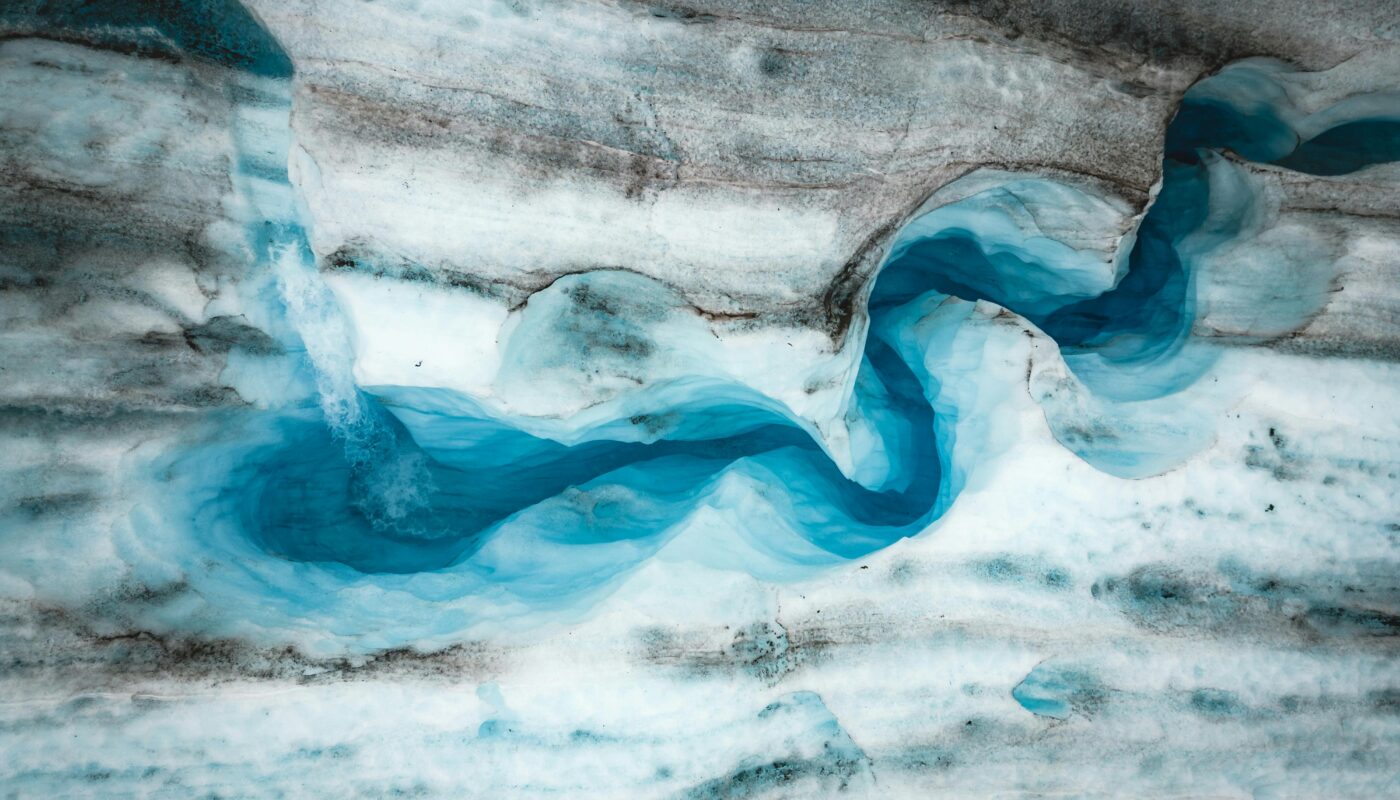
3. Rivers Beneath the Ice
Glaciers are not solid blocks—they often contain channels of flowing water beneath or within them.
This meltwater:
- Lubricates glacier movement
- Carves tunnels beneath the ice
- Eventually drains into oceans or lakes
These hidden rivers can suddenly surge, causing glacial floods known as jökulhlaups, which can dramatically reshape landscapes.
4. Ancient Landscapes and Fossilized Terrain
Beneath glaciers, scientists have discovered landscapes that have been preserved for thousands or even millions of years.
These include:
- Buried valleys
- Ancient riverbeds
- Soil layers from previous warm periods
- Fossilized plant and animal remains in some regions
In places like Greenland, research has revealed that parts of the land beneath the ice were once ice-free ecosystems.
5. Trapped Air and Ice Cores
While not “beneath” the glacier in a geological sense, ice itself contains a record of the past. Deep within glaciers are layers of compacted snow that trap air bubbles.
By drilling ice cores, scientists can extract:
- Ancient atmospheric gases
- Volcanic ash layers
- Temperature records stretching back hundreds of thousands of years
These ice cores act like time capsules, revealing Earth’s climate history.
How Glaciers Shape the Land Beneath Them
Glaciers are powerful geological forces. As they move, they reshape everything beneath them through processes like:
1. Abrasion
Rock fragments embedded in ice act like sandpaper, grinding the ground below.
2. Plucking
Glaciers freeze onto rock and pull pieces away as they move.
3. Pressure Erosion
The immense weight of ice compresses and reshapes underlying surfaces.
Over time, these processes create dramatic landscapes such as fjords, lakes, and mountain valleys.
The Movement of Deep Ice
Even though glaciers may be kilometers thick, they still move. This movement happens in two main ways:
Internal Deformation
Ice crystals slowly shift and deform under pressure, allowing the glacier to flow.
Basal Sliding
If there is meltwater beneath the glacier, it can act as a lubricant, allowing the entire ice mass to slide over bedrock.
This movement is extremely slow—often just centimeters or meters per day—but over centuries, it completely transforms landscapes.
Why Glacier Depth Matters for the Planet
Glacier depth is not just a scientific curiosity—it has global significance.
1. Sea Level Rise
Deep glaciers and ice sheets contain enormous volumes of water. When they melt, sea levels rise worldwide.
2. Freshwater Storage
Ice sheets like those in Greenland and Antarctica store about two-thirds of Earth’s freshwater.
3. Climate History
Deep ice layers preserve records of past climates, helping scientists understand long-term climate change.
4. Ecosystem Influence
Glacial meltwater feeds rivers that support ecosystems and human populations far downstream.
Exploring Beneath the Ice Today
Modern technology has allowed scientists to explore what lies beneath glaciers without fully drilling through them.
Tools include:
- Ice-penetrating radar
- Satellite imaging
- Seismic surveys
- Autonomous underwater robots
These tools reveal hidden lakes, mountain ranges, and complex drainage systems beneath ice sheets that were once completely unknown.
The Most Extreme Example: Antarctica’s Hidden World
The most dramatic example of glacier depth and hidden terrain is found beneath Antarctica.
Beneath its ice sheet lies:
- Mountain ranges taller than many above-ground peaks
- Vast subglacial lakes
- Ancient river systems
- Deep valleys carved before ice coverage
In some places, the ice is so thick that the bedrock is actually below sea level, yet remains buried under kilometers of frozen material.
This makes Antarctica one of the most mysterious and least accessible environments on Earth.
Conclusion: A Hidden Planet Beneath the Ice
So, how deep are glaciers? The answer ranges from modest mountain ice a few dozen meters thick to massive ice sheets more than four kilometers deep. But the true wonder lies not just in their depth, but in what exists beneath them.
Under glaciers are hidden mountains, ancient valleys, flowing rivers, isolated lakes, and records of Earth’s past climate. These frozen giants are not just ice—they are living geological systems that reshape the planet and preserve its history.
Every glacier is therefore a doorway into a hidden world—one that scientists are still uncovering, layer by layer, year by year.