 by
by High mountain and polar environments are undergoing rapid transformation as global temperatures continue to rise. Among the most critical—and often underestimated—changes are the thawing of permafrost and the destabilization of glaciers. While these two processes are sometimes discussed separately, they are deeply interconnected. Together, they form a complex system of environmental feedbacks that significantly increases natural hazards such as landslides, rockfalls, glacial lake outburst floods (GLOFs), and ice avalanches.
Understanding the connection between thawing permafrost and glacier hazards is essential not only for scientists and policymakers but also for communities living in or near mountainous regions, as well as travelers, engineers, and infrastructure planners.
Understanding Permafrost and Its Role in Mountain Stability
Permafrost is ground—soil, rock, or sediment—that remains frozen for at least two consecutive years. In alpine and polar regions, it acts as a kind of “glue” that binds rock faces and mountain slopes together. Ice within fractures and pore spaces helps stabilize otherwise loose material.
In cold mountain environments such as the Alps, Himalayas, Andes, and Arctic regions, permafrost is often found at high elevations where temperatures remain below freezing for much of the year. However, as global temperatures rise, this once-stable frozen ground is beginning to degrade.
When permafrost thaws, the ice that once held rock and sediment together melts. This leads to:
- Loss of structural cohesion in mountain slopes
- Increased water infiltration into rock fractures
- Weakening of rock faces and glacier bedrock interfaces
- Accelerated erosion and slope instability
These changes are not gradual in their effects. Once a threshold is crossed, slope failure can occur suddenly and catastrophically.
How Glaciers Depend on Frozen Ground
Glaciers are not simply masses of ice sitting on bedrock—they are dynamic systems influenced by the conditions beneath them. In many high-altitude environments, glaciers rest on or interact directly with permafrost.
Permafrost plays several stabilizing roles in glacier environments:
- It helps anchor glaciers to mountain slopes
- It reduces basal sliding by keeping the glacier bed frozen
- It maintains the structural integrity of surrounding rock walls
When permafrost thaws, this stability is disrupted. Glaciers may begin to slide more freely, detach from their anchoring points, or become more susceptible to collapse. This is especially dangerous in steep alpine regions where gravity already places significant stress on ice masses.
The Chain Reaction: From Thawing Ground to Glacier Hazards
The most important aspect of the permafrost–glacier relationship is the cascading effect that warming triggers. A small increase in temperature can initiate a chain of events that leads to major hazards.
1. Rock Instability and Rockfalls
As permafrost warms, ice in rock cracks melts, reducing friction and cohesion. Entire sections of mountain faces can become unstable. This often results in rockfalls, which may:
- Directly impact glaciers, triggering ice avalanches
- Deposit debris onto glacier surfaces, altering melt rates
- Block meltwater channels, creating unstable lakes
In many cases, rockfalls are the first visible sign of permafrost degradation.
2. Glacier Surface Darkening and Accelerated Melt
When rock debris falls onto glacier surfaces, it can either insulate or accelerate melting depending on thickness. Thin layers of debris absorb heat and increase ice melt rates. This leads to:
- Faster glacier retreat
- Formation of uneven ice surfaces
- Increased meltwater production
Over time, this destabilizes the glacier structure and contributes to further collapse risks.
3. Formation of Unstable Glacial Lakes
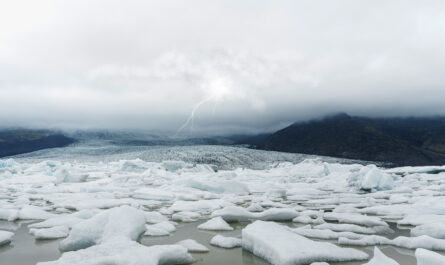
One of the most dangerous consequences of glacier retreat is the formation of glacial lakes. As glaciers melt, water accumulates in depressions left behind by ice.
These lakes are often dammed by:
- Loose moraines (sediment deposits)
- Ice remnants
- Unstable rock structures weakened by permafrost thaw
When these natural dams fail, they can release massive volumes of water in a short time, causing glacial lake outburst floods (GLOFs). These floods can destroy infrastructure, alter river systems, and threaten human settlements downstream.
4. Ice Avalanches and Glacier Collapse
As permafrost thaw weakens the connection between glaciers and surrounding rock, entire sections of ice can detach. This may result in:
- Ice avalanches
- Serac collapses (falling ice towers)
- Sudden glacier break-offs
Such events are extremely dangerous due to their speed and volume. They can travel long distances down valleys, destroying anything in their path.
Regional Hotspots of Risk
While permafrost and glacier interactions occur globally, some regions are particularly vulnerable due to steep terrain and rapid warming.
The European Alps
The Alps are among the most closely studied regions for permafrost degradation. High-altitude peaks such as those in Switzerland and Austria are experiencing increasing rock instability. Mountain infrastructure, including hiking routes, cable cars, and ski resorts, is increasingly exposed to hazard risks.
The Himalayas
Often called the “Third Pole,” the Himalayas contain vast glacier systems feeding major rivers in Asia. Rapid warming is accelerating both glacier retreat and permafrost thaw. This increases the risk of GLOFs, which threaten millions of downstream residents.
The Andes
In South America, tropical glaciers are highly sensitive to temperature changes. Permafrost is less extensive than in polar regions, but still plays a role in stabilizing high peaks. Landslides and glacier lake formation are growing concerns.
The Arctic
In Arctic regions such as Greenland and northern Canada, permafrost covers vast areas. Here, glacier dynamics interact strongly with frozen ground, contributing to coastal instability and ice sheet movement changes.
Climate Change as the Driving Force
The primary driver behind these changes is rising global temperatures. However, the system is amplified by feedback loops:
- Greenhouse gasses like carbon dioxide and methane are released when permafrost thaws.
- Reduced snow and ice cover lowers surface reflectivity (albedo effect)
- Darker surfaces absorb more heat, accelerating warming
This creates a self-reinforcing cycle that further destabilizes both permafrost and glaciers.
Human Impacts and Infrastructure Risks
The consequences of these changes extend far beyond natural landscapes. Human infrastructure in mountain regions is increasingly at risk, including:
- Roads and highways
- Hydropower plants
- Rail systems
- Tourism infrastructure such as ski resorts and mountain lodges
Engineering in permafrost zones is becoming more complex and expensive. Foundations that were once stable are now subject to shifting ground and increased erosion.
Early Warning Signs and Monitoring
Scientists use a combination of technologies to monitor permafrost and glacier stability:
- Ground temperature sensors
- Satellite imagery and remote sensing
- LiDAR mapping of slope changes
- GPS tracking of glacier movement
- Drone-based surveys of unstable terrain
Early warning systems are increasingly important in high-risk regions, especially for detecting potential rockfalls or glacial lake instability.
Mitigation and Adaptation Strategies
While it is not possible to reverse permafrost thaw quickly, steps can be taken to reduce risks:
1. Hazard Mapping
Identifying unstable slopes and glacier lakes helps prioritize monitoring efforts.
2. Controlled Drainage of Glacial Lakes
Engineers sometimes lower water levels in dangerous lakes to reduce flood risk.
3. Infrastructure Adaptation
Building flexible or elevated structures can reduce damage from ground movement.
4. Climate Action
Ultimately, reducing greenhouse gas emissions is the most effective long-term solution.
The Future of Mountain Environments
The connection between thawing permafrost and glacier hazards highlights a critical reality: mountain environments are no longer static. They are dynamic systems responding rapidly to climate change.
In the coming decades, we can expect:
- More frequent rockfalls in alpine regions
- Continued retreat of major glaciers
- Increased formation of unstable glacial lakes
- Greater need for real-time monitoring systems
These changes will reshape landscapes, ecosystems, and human activities in profound ways.
Conclusion
The thawing of permafrost is not an isolated phenomenon—it is deeply intertwined with the stability of glaciers and the safety of mountain environments worldwide. As frozen ground weakens, it triggers a cascade of effects that destabilize ice masses, reshape landscapes, and increase the likelihood of natural disasters.
Understanding this connection is essential for managing future risks. Whether for scientists studying climate systems or travelers exploring high mountain regions, awareness of these hidden processes helps reveal the fragile balance that defines Earth’s cryosphere.