 by
Glaciers may appear solid, massive, and motionless from a distance, but they are constantly moving. Beneath their enormous surfaces, ice flows slowly downhill, responds to changes in terrain, and deforms under its own weight. One of the clearest signs of this movement is the formation of crevasses—deep cracks and fractures that open within glacial ice.
A crevasse can range from a narrow surface crack to a huge opening extending many meters into the glacier. Some are easy to see, while others can be hidden beneath snow bridges, making them particularly important for mountaineers, glacier guides, researchers, and visitors.
But why does glacier ice crack when it is strong enough to survive for centuries?
The answer lies in the way glaciers move.
Glacier ice behaves differently from ordinary ice. Under pressure and over long periods, it can deform and flow almost like an extremely slow-moving substance. However, glacier ice does not behave uniformly everywhere. When parts of a glacier move at different speeds or encounter changes in the landscape, the ice can stretch, bend, and fracture.
These fractures produce crevasses.
Understanding what a crevasse is, how it forms, where it occurs, and why it can be dangerous provides a fascinating look at the physical behavior of glaciers.
What Is a Crevasse?
A crevasse is a fracture or open crack in the surface of a glacier or ice sheet.
Unlike a small crack in an ordinary piece of ice, a crevasse can extend deeply into a glacier.
Some are only a few centimeters wide, while others can become several meters across. Their depth can also vary considerably.
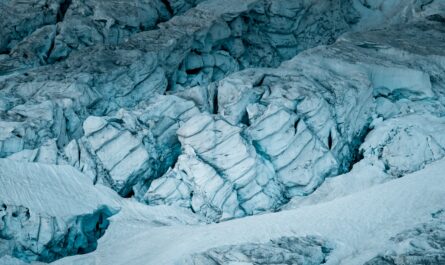
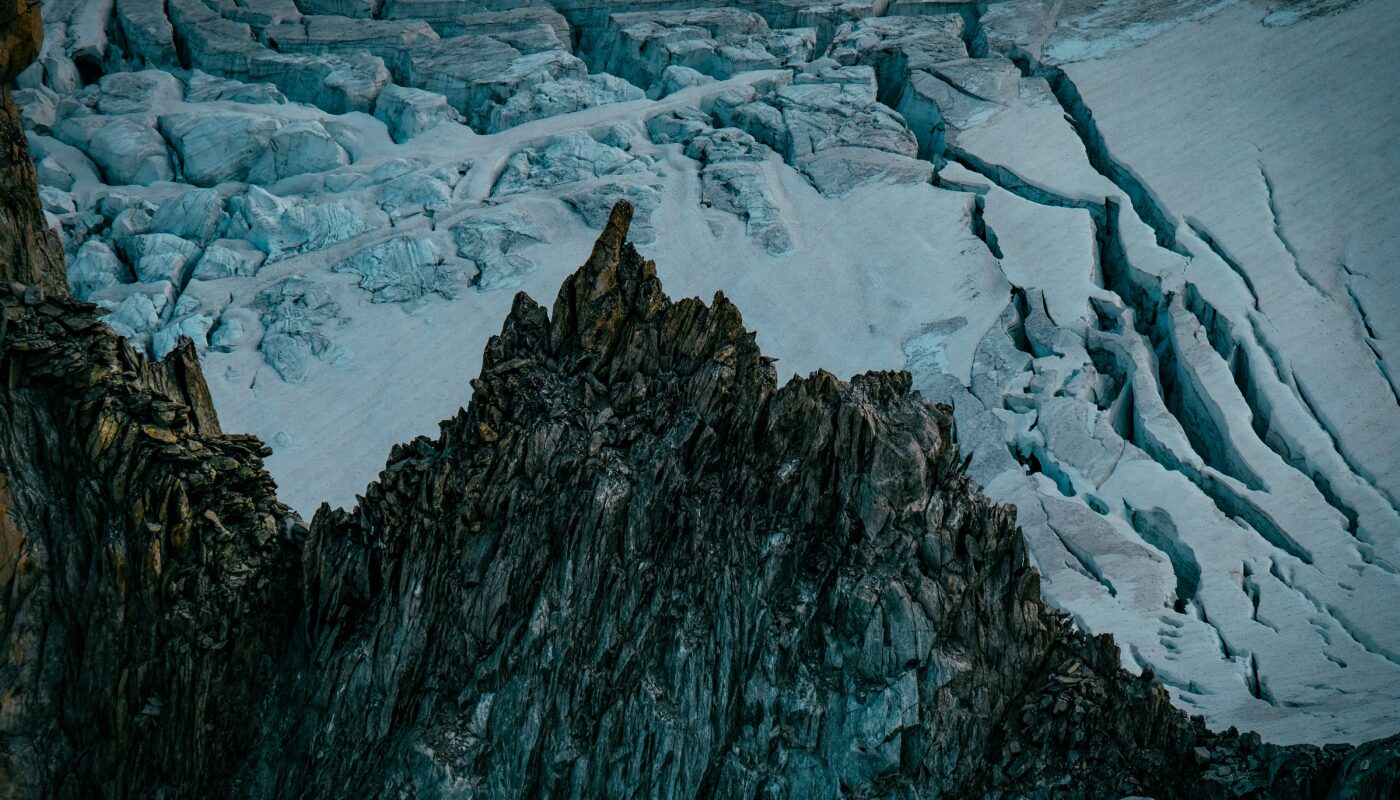
A crevasse may have steep walls of blue, white, or gray ice. Depending on lighting and depth, the bottom may be visible—or it may disappear into darkness.
Crevasses are most common where glacier ice experiences significant stress.
They can form:
- Where the glacier flows over uneven terrain
- Around bends
- Near steep slopes
- Where ice speeds up
- Along the edges of glaciers
- Where the glacier stretches
- Near icefalls
- Where different areas of the glacier move at different speeds
The presence of crevasses is therefore closely connected to glacier movement.
Why Do Glaciers Crack?
The basic reason glaciers develop crevasses is stress.
A glacier is not moving at exactly the same speed everywhere.
The center of a glacier may move differently from its edges. Ice near the surface can behave differently from ice deeper below. A glacier can also accelerate when it travels downhill or encounters a change in slope.
When the ice is subjected to forces that cause it to stretch faster than it can deform smoothly, fractures can develop.
This is similar to bending a rigid object.
If the force becomes greater than the material can accommodate, it breaks.
Glacier ice can deform considerably, but it still has limits.
When those limits are exceeded, a crack may form.
How Does Glacier Ice Move?
To understand crevasses, it helps to understand glacier movement.
A glacier forms when snow accumulates over many years and is compressed into dense ice.
As more snow accumulates, pressure increases.
Eventually, the thick mass of ice begins to move under gravity.
Glacier movement occurs through a combination of processes.
Ice can deform internally, allowing the glacier to flow.
The glacier may also slide over the bed beneath it, especially when meltwater reduces friction.
The exact movement depends on factors such as:
- Ice thickness
- Temperature
- Slope
- Bedrock conditions
- Meltwater
- Snow accumulation
- Glacier geometry
Because different parts of the glacier move differently, stresses develop within the ice.
These stresses can eventually create fractures.
The Role of Tension in Crevasse Formation
One of the most important forces behind crevasses is tension.
Imagine pulling a piece of flexible material from both ends.
The material stretches.
If the stretching becomes too great, it can break.
Glacier ice behaves in a comparable way.
When ice is pulled apart horizontally, tension develops.
If the stress exceeds the ice’s ability to deform without breaking, a crack opens.
This type of stress is particularly important on steep sections of glaciers and areas where the ice accelerates.
Why Are Crevasses Common Near Icefalls?
Icefalls are among the most heavily crevassed parts of many glaciers.
An icefall occurs where a glacier flows over a steep section of terrain.
As the slope increases, the ice can accelerate.
The glacier becomes stretched and deformed as it moves over uneven ground.
This creates intense internal stresses.
The result can be a chaotic landscape of:
- Deep crevasses
- Ice towers
- Cracks
- Seracs
- Fractured ice blocks
Icefalls can be spectacular to look at but are also among the more technically challenging areas for glacier travel.
Crevasses Along the Edges of Glaciers
Crevasses frequently occur near the margins of a glacier.
This happens because the ice near the center of a valley glacier generally moves faster than the ice near the sides.
Why?
The sides of the glacier experience friction against the valley walls.
This slows the ice near the margins.
Meanwhile, the central ice can move more quickly.
The difference in speed creates internal stress.
As the faster-moving central ice pulls away from the slower-moving edge, cracks can develop.
These are sometimes called marginal crevasses.
They may form roughly parallel to the glacier’s sides.
Why Do Crevasses Form in Curved Glaciers?
When a glacier travels around a bend, the ice does not move through the curve in exactly the same way as water flowing around a corner.
Different sections experience different stresses.
The outer portion of the curve can become stretched as the glacier changes direction.
This stretching may produce curved or diagonal crevasses.
Their orientation can provide clues about how the glacier is moving.
Glaciologists can use patterns of fractures and other surface features to understand glacier dynamics.
Transverse Crevasses
One common type is the transverse crevasse.
These often develop across the direction of glacier flow.
They are particularly common where a glacier moves over a steeper section.
As the glacier stretches downhill, cracks can open across its surface.
Transverse crevasses may vary greatly in size and depth.
Some form obvious gaps that can be seen from a distance.
Others may be partly concealed by snow.
Longitudinal Crevasses
Longitudinal crevasses generally run more parallel to the direction of glacier flow.
They can develop when a glacier spreads sideways or experiences particular patterns of stress.
These fractures can sometimes appear in areas where a glacier widens.
Their orientation helps scientists understand how forces are acting within the ice.
Marginal Crevasses
Marginal crevasses occur close to the sides of a glacier.
The main cause is often the difference in speed between ice near the glacier’s center and ice near its edges.
The center can move faster, while friction slows the margins.
The resulting shear stress can fracture the ice.
These crevasses may form diagonal patterns extending inward from the glacier margins.
Hidden Crevasses: Why Snow Can Be Dangerous
One of the biggest hazards associated with crevasses is that they are not always visible.
Fresh snow can cover a crack.
The resulting layer is called a snow bridge.
From above, the snow may look like an ordinary part of the glacier surface.
But underneath, there may be an open void.
A person, animal, or piece of equipment can break through the snow bridge.
This is one reason glacier travel requires specialized knowledge and appropriate safety procedures.
Experienced guides assess the terrain, snow conditions, recent weather, and known crevasse patterns before selecting a route.
Why Are Crevasses Blue?
Visitors are often surprised by the intense blue color visible inside some crevasses.
Glacial ice can appear blue because of the way it absorbs and transmits light.
Ice absorbs more of the longer wavelengths of visible light, such as red, while shorter blue wavelengths can penetrate farther and be scattered back toward the observer.
Dense glacier ice often contains fewer air bubbles than ordinary snow or newly formed ice.
As light travels through thick, compact ice, its color can become increasingly blue.
The deeper the ice, the more dramatic the effect can sometimes appear.
This is why photographs of glacier crevasses often show brilliant blue walls.
Are Crevasses Always Open?
No.
A crevasse can open, widen, narrow, or become partially closed.
Glaciers are constantly moving.
As ice changes position, fractures can deform.
Snow can accumulate inside them.
Ice walls can collapse.
Nearby cracks can shift.
A crevasse that was clearly visible during one season may look very different later.
This is one reason glacier routes cannot always be treated as permanent trails.
Can Crevasses Move?
The crevasse itself is part of the moving glacier.
As the glacier flows downhill, the crack moves with the surrounding ice.
Its shape can also change as the glacier stretches and deforms.
This makes glaciers fundamentally different from stationary landscapes.
A rocky mountain pass may remain recognizable for centuries.
A crevasse can change significantly within a much shorter period.
Seasonal Changes in Crevasses
Crevasse visibility and conditions can vary with the seasons.
During warmer periods, increased surface melting can alter snow bridges and expose previously hidden cracks.
Fresh snowfall can cover crevasses during colder periods.
Snow accumulation may make a glacier look smoother while concealing dangerous gaps underneath.
Freeze-thaw processes can also influence ice conditions.
This seasonal variability is one reason professional glacier guides evaluate current conditions rather than relying entirely on previous route information.
How Deep Can a Crevasse Be?
There is no single standard depth.
Some crevasses are relatively shallow.
Others can extend many meters into the glacier.
In exceptionally large glacier systems, fractures can become very deep.
The visible opening does not necessarily reveal the full structure beneath the surface.
A narrow crack may widen below the surface, while a broad opening may have irregular ice walls.
This uncertainty is another reason that approaching a crevasse without proper knowledge can be hazardous.
What Happens at the Bottom of a Crevasse?
A crevasse may contain ice, snow, debris, meltwater, or a combination of these materials.
Some extend into deeper parts of the glacier.
Others may partially close beneath the surface.
Water can collect in some fractures during periods of melting.
In certain circumstances, meltwater can travel through cracks and channels toward the glacier’s interior or base.
These processes can influence how water moves through a glacier.
Crevasses and Glacier Meltwater
Crevasses are not only cracks on the surface.
They can also provide pathways for water.
During warm periods, snow and ice melt at the surface.
Meltwater can enter crevasses and travel downward.
In some glaciers, surface water can reach deep within the ice and potentially influence movement at the glacier bed.
Water at the base of a glacier can reduce friction between ice and bedrock.
This may influence how quickly parts of the glacier move.
Scientists study these relationships because understanding glacier motion is important for predicting how glaciers respond to environmental change.
Crevasses and Climate Change
Climate change can influence glaciers in complex ways.
Many glaciers around the world are losing ice as temperatures rise, although individual glaciers respond differently depending on local conditions.
As glaciers thin and retreat, their geometry changes.
Changes in slope, thickness, and flow speed can influence where and how crevasses develop.
A retreating glacier does not necessarily become less crevassed.
In some areas, changes in ice flow can create new fractures.
Elsewhere, crevasses may become inactive as sections of ice stagnate.
Therefore, crevasse patterns can provide useful information about changing glacier dynamics.
Why Crevasses Matter to Scientists
Crevasses are natural indicators of stress and movement within glaciers.
By studying them, scientists can investigate:
- Ice velocity
- Glacier deformation
- Changes in glacier geometry
- Surface stress
- Meltwater movement
- Icefall dynamics
- Glacier stability
Modern researchers can combine field observations with satellite imagery, drones, GPS measurements, and computer models.
These tools allow scientists to monitor how fractures change over time.
Crevasse patterns can therefore contribute to a much larger understanding of glacier behavior.
Why Crevasses Are Dangerous for Hikers
A glacier can look deceptively safe.
From a distance, its surface may appear smooth and covered in snow.
But hidden crevasses can exist beneath that surface.
The danger is not limited to falling into a large open crack.
A person can also break through a thin snow bridge into a concealed cavity.
Potential consequences include:
- Falls
- Serious injuries
- Entrapment
- Hypothermia
- Difficult rescue situations
The risk becomes particularly significant in unfamiliar terrain.
For this reason, people should not simply walk onto an unmarked glacier because it appears accessible.
How Professional Glacier Guides Deal With Crevasses
Professional guides use a combination of knowledge, observation, route planning, and technical equipment when traveling across glaciers.
Depending on the environment and activity, safety techniques may include:
- Roped glacier travel
- Harnesses
- Crampons
- Ice axes
- Helmets
- Crevasse rescue equipment
- Probing suspected snow bridges
- Careful route selection
The appropriate techniques depend on the glacier, terrain, season, group, and type of excursion.
A short guided glacier walk does not necessarily involve the same procedures as a technical mountaineering expedition.
The important point is that glacier travel should be approached as a specialized outdoor activity rather than an ordinary hike.
Can You See a Crevasse From a Boat?
Sometimes.
Travelers on glacier cruises or boat tours may see large fractures in the lower portions of glaciers that reach the water.
However, most crevasses form and are visible on the glacier surface rather than at the submerged base.
A boat provides a useful perspective for observing the enormous scale of a glacier, but it does not reveal the full network of cracks hidden within the ice.
Crevasses vs. Bergschrunds
Crevasses are sometimes confused with bergschrunds, but the two terms describe different features.
A bergschrund is a large crack that can form near the upper edge of a glacier where moving glacier ice separates from relatively stationary snow or ice above it.
The opening can expose rock or deep ice.
Although both features involve fractures, their positions and formation processes differ.
This distinction is particularly relevant in mountaineering and glaciology.
Can Crevasses Ever Close Completely?
Yes.
A crevasse can narrow or close as the glacier deforms.
Snow can fill the opening.
Ice walls can move toward each other.
Pressure within the glacier can gradually alter the fracture.
But a closed-looking surface does not necessarily mean the underlying hazard has disappeared.
A crack may remain hidden beneath snow or compacted ice.
This is why surface appearance alone can be misleading.
How Technology Helps Detect Crevasses
Modern technology is making glacier travel and scientific research increasingly sophisticated.
Researchers can use:
Satellite imagery
Large-scale satellite images can reveal extensive crevasse fields and changes in glacier structure.
Drones
Uncrewed aerial vehicles can capture detailed images of difficult terrain.
Ground-penetrating radar
Radar can help investigate structures beneath the surface in certain conditions.
GPS
GPS measurements can track movement across glacier surfaces.
Computer modeling
Models can simulate ice flow and predict where stress may increase.
No technology eliminates all uncertainty, but combining multiple methods provides a better understanding of glacier hazards.
Famous Glacier Regions Where Crevasses Occur
Crevasses are found in glaciers across the world.
Examples include glacier regions in:
- Greenland
- Antarctica
- Alaska
- Canada
- Iceland
- Norway
- Patagonia
- The Alps
- The Himalayas
- New Zealand
Each region has its own glacier characteristics.
A valley glacier in the Alps may behave differently from a huge outlet glacier in Greenland or an Antarctic ice stream.
Nevertheless, the fundamental relationship between ice movement and stress remains important everywhere.
What Should Tourists Know Before Visiting a Glacier?
Visitors don’t need to become glaciologists before taking a guided glacier tour.
However, understanding basic glacier hazards is useful.
Before booking, ask:
- Is the tour actually on the glacier?
- Is a qualified glacier guide provided?
- What equipment is included?
- What fitness level is required?
- What happens if weather changes?
- How does the company handle crevasse hazards?
- Is the route suitable for beginners?
A reputable operator should provide clear answers.
Never assume that a glacier is safe simply because other tourists have visited the same area.
Conditions can change quickly.
Why Crevasses Make Glaciers Fascinating
Crevasses are more than hazards.
They are evidence that glaciers are moving.
A completely rigid block of ice would not develop the complex fracture patterns seen across active glaciers.
Crevasses reveal how ice responds to gravity, terrain, speed, pressure, and changing geometry.
They show that a glacier is not a frozen landscape in the ordinary sense.
It is a dynamic system.
The cracks are physical records of forces acting inside the ice.
Final Thoughts
A crevasse is a deep fracture in glacial ice created when stresses within a moving glacier exceed the ice’s ability to deform without breaking.
These cracks can form when glaciers accelerate, move over steep or uneven terrain, bend around corners, spread outward, or encounter differences in movement between the center and edges.
Some crevasses are dramatic and easy to see. Others can be concealed beneath snow and become much more difficult to recognize.
Their formation is closely connected to the fundamental behavior of glaciers. Ice may look solid and stationary, but a glacier is actually flowing slowly under the influence of gravity. As it moves through changing terrain, different parts experience different forces. Those forces produce tension, compression, and shear, eventually creating fractures where the stress becomes strong enough.
Crevasses can also provide scientists with valuable information. Their locations, orientations, and changes over time can help researchers understand glacier movement and the effects of changing environmental conditions.
For travelers, however, crevasses are primarily a safety consideration. A glacier should never be treated like an ordinary hiking trail. Hidden cracks and unstable snow bridges can make apparently simple terrain dangerous.
The best way to appreciate these extraordinary formations is with appropriate preparation and, when traveling on glacial ice, qualified professional guidance.
Ultimately, crevasses remind us that glaciers are not static monuments left behind by the Ice Age. They are moving, changing rivers of ice, constantly responding to gravity, climate, water, and the landscape beneath them.
That dynamic behavior is what makes glaciers both scientifically fascinating and visually spectacular—and it explains why every glacier journey can reveal something different.