 by
Introduction
Deep in the Peruvian Andes, an enormous frozen landscape stretches across a remote mountain plateau, creating one of the most unusual glacier environments on the planet. This remarkable natural formation is known as the Quelccaya Ice Cap. Situated in southeastern Peru, it is widely recognized as the world’s largest tropical ice cap and represents an important part of the Earth’s high-altitude climate system.
What makes Quelccaya particularly interesting is its geographical position. Unlike the enormous ice sheets of Antarctica and Greenland, this frozen landscape exists within the tropics, far from the traditional polar regions. Its survival is possible because of its exceptional elevation, where low temperatures allow snow to accumulate and develop into thick layers of glacier ice.
Beyond its impressive appearance, Quelccaya has enormous scientific importance. Its frozen layers contain information about historical weather conditions, atmospheric changes, and ancient environmental events. Researchers have studied these deposits to understand how tropical climates behaved long before modern instruments began recording temperatures and rainfall.
Unfortunately, this extraordinary ice formation is experiencing considerable changes. Increasing temperatures, shifting rainfall patterns, and the influence of climate phenomena such as El Niño are contributing to its gradual retreat.
Understanding the Quelccaya Ice Cap means exploring more than a remote glacier. It provides an opportunity to examine climate history, freshwater resources, mountain ecosystems, and the environmental challenges facing tropical regions.
1. Discovering the Location of Quelccaya Ice Cap
The Quelccaya Ice Cap lies within the Cordillera Vilcanota, a mountain range in southeastern Peru. Its geographical coordinates are approximately 13°56′ south and 70°50′ west, while its summit reaches roughly 5,670 meters above sea level.
The surrounding region forms part of the extensive Andean mountain system, which stretches along the western side of South America. Its dramatic landscape includes rocky peaks, high-altitude valleys, grasslands, glacial lakes, and snow-covered slopes.
Although the ice cap is located within a tropical latitude, its extreme elevation creates conditions suitable for permanent ice. Temperatures remain sufficiently low for accumulated snowfall to survive from one season to another.
Quelccaya covers a broad elevated surface rather than occupying a single narrow mountain valley. Several outlet glaciers extend from its margins, carrying ice toward lower surrounding areas.
The landscape is also connected to the wider water systems of the Andes. Streams, wetlands, and mountain rivers receive water from precipitation and glacier melt, supporting both natural habitats and nearby communities.
2. What Makes Quelccaya a Tropical Ice Cap?
The word tropical usually brings to mind warm weather, strong sunshine, and lush vegetation. However, geographical location does not determine temperature by itself. Elevation plays an equally important role.
As air rises through the atmosphere, it generally becomes cooler. This explains why extremely high mountains can support snowfields and glaciers even when they are located relatively close to the equator.
Quelccaya demonstrates this geographical phenomenon particularly well.
The ice cap receives intense solar radiation because of its tropical position, but its high elevation creates cold conditions that allow snow to accumulate. The combination of seasonal snowfall and low temperatures helps maintain its frozen surface.
Its tropical setting also makes it different from polar glaciers. Changes in rainfall, cloud cover, atmospheric circulation, and ocean temperatures can strongly influence its condition.
Scientists therefore consider Quelccaya an important natural laboratory for studying tropical climate behavior and the relationship between global warming and glacier retreat.
3. How Did the Quelccaya Ice Cap Develop?
The formation of the Quelccaya Ice Cap involved a gradual accumulation of snow over a very long period.
At high elevations, some snowfall remains frozen throughout the year. When fresh snow settles over older deposits, the increasing weight compresses the lower layers.
Over time, individual snowflakes become compacted into a dense material called firn. Continued pressure reduces the spaces between snow particles, eventually transforming the accumulated material into solid glacier ice.
As the ice becomes thicker, gravity causes it to move slowly across the underlying mountain surface.
This movement creates the glacier system visible today, including the main ice-covered plateau and its surrounding outlet glaciers.
The survival of Quelccaya depends on two opposing processes:
Snow accumulation: New snowfall adds material to the glacier and helps maintain its frozen reserves.
Ice loss: Melting, sublimation, and the removal of snow or ice reduce its total mass.
When snowfall replaces the amount of ice lost, the glacier can remain relatively stable. However, when melting consistently exceeds accumulation, the ice cap begins to shrink.
This natural balance is particularly sensitive to changes in temperature and precipitation, making tropical glaciers important indicators of environmental change.
4. Understanding the Climate Around Quelccaya
Despite being located in the tropics, Quelccaya experiences a cold mountain climate throughout the year. Its weather is strongly influenced by elevation, seasonal precipitation, atmospheric circulation, and exposure to sunlight.
The region generally experiences two major seasons.
Wet season
The wet season usually extends from November through April. During this period, moisture from the surrounding atmospheric systems contributes to increased precipitation across the Andes.
Snowfall at higher elevations can add fresh material to the ice cap. Cloud cover may also reduce the amount of direct sunlight reaching its surface.
However, the amount of snowfall varies considerably between years. Not every wet season provides enough fresh snow to compensate for existing ice loss.
Dry season
The dry season generally occurs between May and October. Rainfall becomes less frequent, and clearer skies expose the glacier to stronger solar radiation.
When surface temperatures rise, exposed ice can melt more rapidly. Reduced snowfall also means that less fresh snow is available to protect older ice from sunlight.
These seasonal differences play an important role in determining the annual condition of Quelccaya.
Another major influence is the El Niño–Southern Oscillation, commonly known as ENSO. This climate phenomenon changes ocean temperatures and atmospheric circulation across the tropical Pacific.
Research published in 2024 found that El Niño events can intensify snowline elevation and ice loss at Quelccaya. The study also identified a relationship between La Niña conditions and increases in snow-covered area during most observed La Niña years.
These findings demonstrate how distant ocean conditions can influence glaciers located high in the Peruvian mountains.
5. Quelccaya’s Ice Cores: A Frozen Record of Climate History
One of the most valuable characteristics of Quelccaya is its ability to preserve historical environmental information.
Snow accumulating on the ice cap forms layers that can retain dust, atmospheric chemicals, volcanic material, and other particles. These deposits provide clues about the environmental conditions present when each layer originally formed.
Scientists collect cylindrical samples known as ice cores to investigate these records.
Important research expeditions were conducted during the 1970s and 1980s by glaciologists associated with Ohio State University, including Lonnie Thompson and his research team.
In 1983, researchers successfully drilled ice cores down to bedrock using a solar-powered drilling system. These samples provided an important opportunity to reconstruct tropical climate conditions over many centuries.
Scientists analyze different characteristics of the collected material, including:
- Oxygen isotopes: Variations in these chemical signatures help researchers investigate historical temperature and moisture conditions.
- Dust concentrations: Mineral particles can reveal changes in atmospheric circulation and environmental conditions.
- Chemical deposits: Different substances preserved in the ice provide information about atmospheric processes.
- Volcanic ash: Certain deposits can help scientists identify historical volcanic events.
The ice cores from Quelccaya are especially valuable because they preserve annually resolved tropical climate information extending well over a thousand years.
Such records help scientists understand historical droughts, rainfall variations, and changes in regional atmospheric circulation.
Once glacier ice disappears, much of this information may become impossible to recover.
6. Why Scientists Consider Quelccaya Important
The Quelccaya Ice Cap provides an unusual opportunity to investigate how tropical climate systems have changed over time.
Unlike conventional weather records, which cover relatively recent periods, glacier deposits can preserve evidence from centuries or even millennia ago.
Researchers compare ice-core information with lake sediments, historical vegetation remains, satellite observations, and modern weather measurements.
These different sources help build a more complete picture of environmental changes across the Andes.
Research at Quelccaya is particularly useful for investigating:
- Historical drought conditions in South America.
- The influence of Pacific Ocean temperature changes on Andean precipitation.
- The relationship between snowfall and glacier survival.
- Long-term variations in tropical atmospheric circulation.
- The environmental consequences of increasing global temperatures.
The information also helps researchers improve their understanding of other tropical glaciers in South America, Africa, and Asia.
In this way, Quelccaya contributes to climate science far beyond the boundaries of Peru.
7. The Shrinking Ice Cap and Evidence of Glacier Retreat
One of the most serious environmental concerns surrounding Quelccaya is the reduction of its ice-covered area.
Satellite images have revealed substantial changes along its margins over recent decades.
According to NASA observations, the ice cap covered approximately 58 square kilometers in 1988. By 2023, its estimated area had fallen to just over 40 square kilometers.
A separate scientific investigation published in 2024 examined satellite observations between 1985 and 2022. Researchers estimated that the total ice-covered area declined by approximately 37 percent during that period, while the seasonal snow-covered area decreased by around 58 percent.
These measurements show that the changes involve more than the disappearance of ice along the outer edges. The amount of snow covering the glacier has also declined significantly.
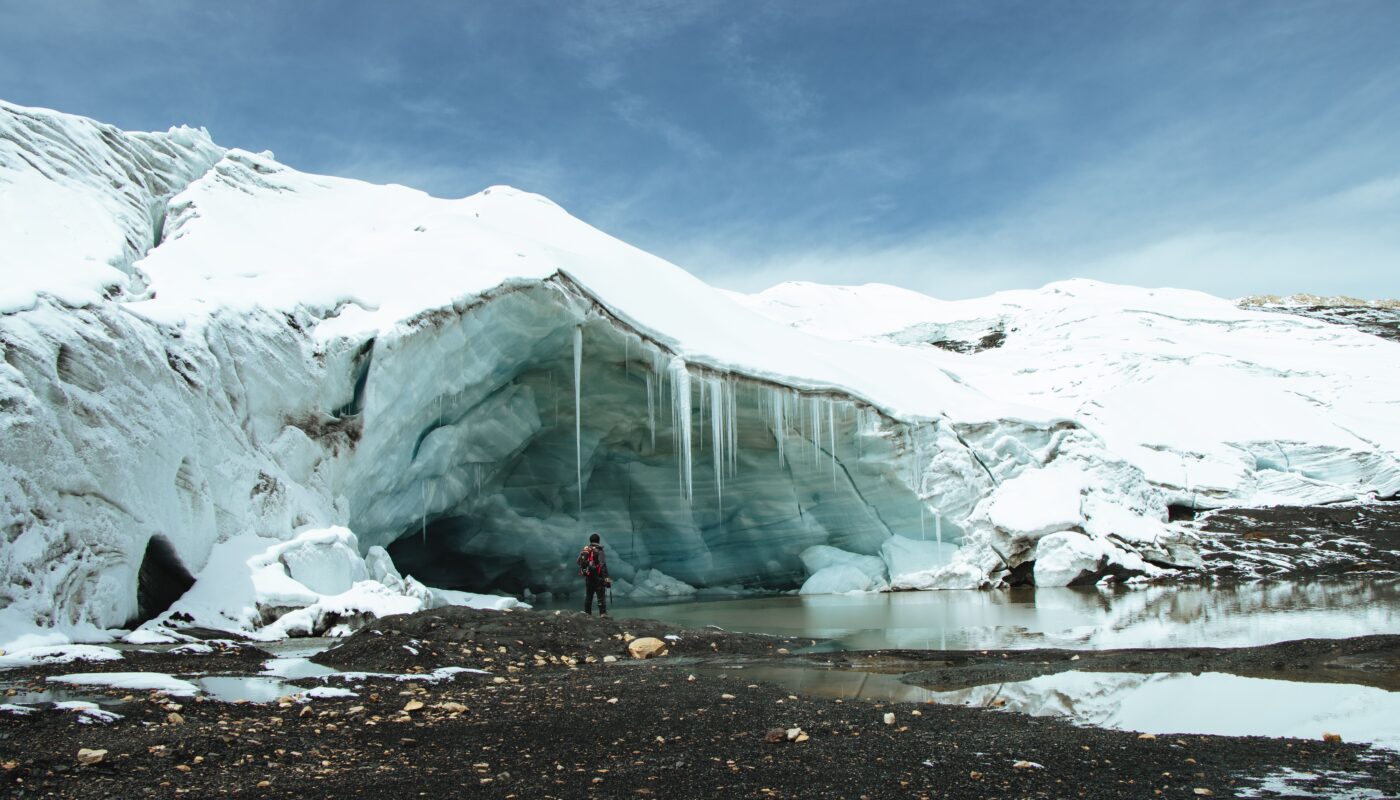
As the ice retreats, previously hidden rocky surfaces become visible. Meltwater ponds and lakes have also developed around parts of the glacier.
These changes can alter the surrounding landscape and affect the movement and storage of water.
The retreat is not necessarily identical across every part of the ice cap. Different margins respond differently depending on elevation, slope, local climate, and underlying terrain.
Nevertheless, the overall trend demonstrates the growing vulnerability of this tropical glacier system.
8. What Does El Niño Have to Do With Glacier Melting?
El Niño is an important climate phenomenon that influences weather patterns across large parts of the world.
It occurs when sea-surface temperatures in the central and eastern tropical Pacific become unusually warm. These ocean changes affect atmospheric circulation and can influence rainfall and temperature in South America.
For Quelccaya, the effects can be particularly significant.
During some El Niño events, reduced snowfall and warmer conditions contribute to greater ice loss. Less fresh snow means that older, darker ice becomes exposed, allowing the glacier surface to absorb more solar energy.
A 2024 study published in The Cryosphere investigated these relationships using satellite observations covering almost four decades.
The researchers found that El Niño events were associated with increased snowline elevation and reduced snow-covered area.
This is important because the snowline helps indicate the balance between glacier accumulation and ice loss.
When the snowline moves upward, a larger proportion of the glacier may experience conditions associated with melting rather than snow accumulation.
The research demonstrates that Quelccaya is influenced by both long-term global warming and shorter-term climate variations.
9. How Glacier Retreat Affects Water Availability
The importance of Quelccaya extends beyond its frozen appearance. Its surrounding glaciers form part of a mountain environment that contributes water to rivers, streams, and wetlands.
For communities living in the Andes, these water sources support everyday activities and agricultural production.
Glacier meltwater can be particularly useful during periods when rainfall is limited. It supplements other water sources and helps maintain river flow during dry conditions.
However, glacier retreat creates a complicated situation.
When melting increases, a glacier may temporarily release larger quantities of water. This can create the impression that more water will always be available.
In reality, glaciers contain a limited reserve of frozen freshwater. As their volume decreases, their contribution to rivers can eventually decline.
Scientists describe the maximum contribution of glacier meltwater before a longer-term reduction as peak water.
After this point, communities may experience increasing difficulties maintaining reliable water supplies during dry seasons.
Potential consequences include:
- Greater pressure on irrigation systems.
- Reduced water availability for livestock.
- Changes in wetland conditions.
- Increased competition for freshwater.
- Challenges for agricultural planning.
The situation highlights the importance of preparing water management strategies before glacier reserves decline further.
10. Plants and Animals Around the Quelccaya Region
Although the ice-covered surface offers limited opportunities for vegetation, the surrounding mountain landscape supports a range of specialized plants and animals.
One important ecosystem is the Puna grassland, a high-altitude environment characterized by cold temperatures, strong winds, and relatively sparse vegetation.
Ichu grass is among the recognizable plants of this region. Its tough structure allows it to survive challenging mountain conditions and provides food for grazing animals.
The surrounding environment also supports wildlife adapted to life at high elevations.
Vicuñas are particularly well known in the Peruvian Andes. These wild South American camelids feed on high-altitude vegetation and are adapted to the cold, open grasslands.
Andean foxes also inhabit parts of the region, while various bird species use mountain wetlands and grasslands for feeding and shelter.
Small water bodies and wetlands provide important habitats for organisms that depend on reliable freshwater conditions.
As glacier ice retreats, new areas of exposed ground may gradually become colonized by vegetation. However, this process does not automatically restore the previous ecosystem.
Changes in soil moisture, water availability, and temperature can create new environmental pressures.
Protecting the Quelccaya region therefore involves considering its entire ecological landscape rather than focusing only on the glacier.
11. Quelccaya and Its Importance to Local Communities
The Andes have supported human communities for thousands of years. People living in these mountainous environments have developed agricultural systems and traditional practices suited to difficult geographical conditions.
Water has always been an essential resource for these communities.
Rivers, wetlands, seasonal rainfall, and glacier-fed streams contribute to the survival of livestock, crops, and natural vegetation.
The mountain environment also holds cultural importance in Andean traditions. Mountains are often associated with spiritual beliefs, traditional knowledge, and connections between communities and their surrounding natural world.
Changes in glacier conditions can therefore affect more than water supplies.
They can influence local livelihoods, agricultural decisions, and the relationship between communities and familiar mountain landscapes.
Understanding these connections is important when developing environmental protection and climate adaptation strategies.
12. Can Travelers Visit the Quelccaya Ice Cap?
For travelers interested in remote mountain landscapes, Quelccaya offers a remarkable opportunity to experience one of Peru’s most unusual natural environments.
However, visiting the ice cap requires considerably more preparation than exploring popular tourist destinations around Cusco.
The journey generally involves traveling toward the Cordillera Vilcanota and continuing through remote high-altitude terrain.
Depending on the route, visitors may need to undertake a lengthy trek to reach suitable viewpoints or the glacier’s surroundings.
Several important considerations should be kept in mind.
Altitude preparation: At elevations above 5,000 meters, the risk of altitude sickness is significant. Travelers should allow time for acclimatization and seek medical advice about high-altitude travel.
Physical preparation: Walking across uneven mountain terrain requires good physical preparation and suitable footwear.
Weather conditions: Temperatures can become extremely cold, and sudden changes in wind, snowfall, or visibility may affect travel plans.
Appropriate equipment: Waterproof clothing, warm layers, gloves, sunglasses, sunscreen, and suitable trekking equipment are essential.
Experienced guides: Because the area is remote and potentially hazardous, traveling with knowledgeable local guides is strongly recommended.
Visitors should also respect the fragile environment. Leaving rubbish, disturbing wildlife, or walking onto unstable glacier surfaces can create unnecessary environmental and safety risks.
Responsible travel helps protect the landscape while allowing people to appreciate its natural importance.
13. What Could Happen to Quelccaya in the Future?
The future condition of the Quelccaya Ice Cap will depend on changes in global temperatures, regional precipitation, and greenhouse gas emissions.
Scientists have used climate models to investigate how the glacier might respond to different warming scenarios.
A study published in 2018 examined the possibility that the equilibrium line could eventually rise above the ice cap’s highest elevations under a high-emissions scenario.
The equilibrium line is the approximate boundary separating the glacier’s accumulation area from its ablation area.
If this boundary rises above the glacier’s summit, the ice cap could experience persistent ice loss across almost its entire surface.
Such projections do not establish an exact disappearance date. They illustrate possible future outcomes under particular climate assumptions.
Several actions can help reduce the pressures facing Quelccaya:
Reducing global emissions: Limiting greenhouse gas emissions is essential for slowing the warming that threatens glaciers worldwide.
Continuing scientific monitoring: Satellite observations, ice measurements, and climate research can help identify changes in glacier conditions.
Improving freshwater management: Better storage systems and efficient irrigation can help communities prepare for changing water supplies.
Conserving mountain ecosystems: Protecting wetlands, grasslands, and surrounding habitats can support ecological resilience.
Although these measures cannot immediately replace lost glacier ice, they can help communities prepare for environmental changes and reduce future risks.
14. Why Preserving Quelccaya Matters to the Entire World
The Quelccaya Ice Cap is important not only because of its size or geographical location but also because of the information it preserves.
Its ice contains evidence of historical atmospheric conditions that help scientists understand how the tropical climate system has changed over time.
The loss of these deposits would remove a valuable natural archive.
Its retreat also highlights the wider consequences of global warming. Changes occurring in a remote part of Peru can influence freshwater resources, mountain ecosystems, and local communities.
Furthermore, Quelccaya provides an important example of how climate change affects places far beyond the Arctic and Antarctic.
Tropical glaciers may occupy relatively small areas compared with polar ice sheets, but their environmental and scientific value is considerable.
Protecting them requires international climate action, continued research, and practical support for communities living in vulnerable mountain regions.
Conclusion
The Quelccaya Ice Cap represents one of the most fascinating natural environments in the Peruvian Andes. Its unusual tropical location, extensive frozen surface, and remarkable historical records make it an important destination for scientists and an extraordinary feature of the global climate system.
Its ice layers provide valuable information about past environmental conditions, while its surrounding landscape supports specialized mountain ecosystems and contributes to regional freshwater resources.
However, the glacier is changing rapidly. Satellite observations and scientific investigations reveal substantial reductions in its ice-covered and snow-covered areas. Increasing temperatures and changing precipitation patterns are creating serious challenges for its long-term survival.
The story of Quelccaya is therefore much bigger than the retreat of a single glacier. It demonstrates how closely mountain environments are connected to global climate patterns, water availability, and human activities.
Preserving this remarkable ice cap means protecting an important source of scientific knowledge and recognizing the environmental needs of the communities and ecosystems that depend on the Andes.