by
Many people visualize glaciers as massive rivers of ice flowing slowly through mountain valleys. From a distance, they may appear peaceful, silent, and almost motionless. However, beneath their frozen surfaces, powerful forces are constantly at work. Ice moves under its own weight, responds to gravity, and changes shape as it travels across uneven landscapes. In certain places, these movements create one of the most dramatic features found in glacial environments: an icefall.
An icefall is a section of a glacier where the ice flows over a steep slope, a sudden drop in the landscape, or an area of uneven terrain. As the glacier moves downhill, its surface becomes fractured, producing deep crevasses, towering ice blocks, sharp ridges, and irregular formations known as seracs. The resulting landscape can look like a frozen waterfall that has been broken into countless pieces.
Unlike the relatively smooth sections of a glacier, an icefall is often unstable and constantly changing. Cracks widen, ice towers collapse, and new fractures appear as the glacier continues its journey. This combination of movement, pressure, and gravity makes icefalls some of the most dangerous natural features encountered by mountaineers and glaciologists.
Although icefalls can be hazardous, they also provide valuable information about how glaciers behave. Studying them helps scientists understand ice movement, glacier dynamics, and the effects of changing environmental conditions on mountain landscapes.
In this article, we will explore what an icefall is, how it forms, why it is so chaotic, what makes it dangerous, and why these extraordinary formations are important to the natural world.
1. What Exactly Is an Icefall?
An icefall is a steep, heavily fractured section of a glacier where flowing ice encounters a significant change in the underlying terrain. This change may be caused by a steep valley, a rocky step, or a sudden increase in the gradient of the ground beneath the ice.
To understand an icefall, it helps to think of a glacier as a slow-moving river made of ice. When a river flows over a steep ledge, its water drops and accelerates. A glacier responds differently because solid ice cannot flow around obstacles as freely as liquid water. Instead, it deforms, stretches, and breaks under stress.
As the ice moves over a steep section, its upper layers may stretch faster than the ice can adjust internally. This produces tension, leading to cracks and deep openings. Meanwhile, other parts of the glacier may be compressed, pushed upward, or tilted into unstable positions.
The result is a rugged collection of ice formations that can include:
- Crevasses: Deep cracks that develop when glacier ice fractures under stress.
- Seracs: Large, isolated towers or blocks of ice separated by fractures.
- Ice ridges: Raised formations created by uneven movement and deformation.
- Overhanging ice: Unstable sections that project outward and may eventually collapse.
- Snow bridges: Snow-covered openings that can conceal dangerous crevasses beneath the surface.
An icefall is not simply a collection of cracks in a glacier. It is an active zone where ice movement and deformation create a constantly changing landscape.
The height, width, and complexity of an icefall depend on the glacier’s size, its speed, the shape of the underlying ground, and the environmental conditions surrounding it.
2. How Does an Icefall Form?
Icefalls develop through the interaction of gravity, glacier movement, and the shape of the land beneath the ice. Their formation is a natural process that can take place over long periods, although individual fractures and collapses may occur much more quickly.
Step 1: The glacier begins moving downhill
Glaciers form when snow accumulates over many years and gradually compresses into dense ice. Under sufficient pressure, the accumulated ice begins to move downhill under gravity.
This movement is generally slow, but the speed varies considerably between glaciers and even between different sections of the same glacier.
Step 2: The glacier reaches a steep slope
When the glacier travels across relatively gentle terrain, its movement may remain comparatively smooth. However, when it reaches a steep drop or a sudden change in the bedrock, the ice above that area must adjust to the changing slope.
The upper part of the glacier may move more rapidly down the incline, creating greater differences in movement between neighboring sections.
Step 3: Stress builds inside the ice
Ice is capable of deforming under pressure, but it also behaves as a brittle material when stress develops faster than it can accommodate through deformation.
As different parts of the glacier move at different speeds, tension and compression develop within the ice. The upper surface is particularly vulnerable to fractures because it is less confined by surrounding ice than deeper layers.
Step 4: Crevasses and seracs develop
The ice breaks when the stress gets too high. The glacier is divided into several blocks and towers by large fissures that spread over its surface.
Some blocks tilt or become unstable, while others remain temporarily supported by surrounding ice. These formations create the broken, chaotic appearance associated with an icefall.
Step 5: The ice continues changing
The process does not end once the fractures appear. As the glacier advances, existing cracks widen, ice blocks shift, and new fractures develop.
Some formations collapse under gravity, while others are carried farther down the glacier. Fresh snowfall may conceal openings, making the surface look smoother than it really is.
This continuous cycle of movement and breakage explains why an icefall rarely remains unchanged for long.
3. Why Is an Icefall Considered the Most Chaotic Part of a Glacier?
The word chaotic describes an icefall particularly well because its surface is shaped by many interacting forces. An icefall has several unstable formations that react differently to shifting loads, in contrast to a comparatively level area of a glacier.
Several factors contribute to this disorder.
Uneven ice movement
Not every part of a glacier moves at the same speed. Ice near the valley walls may move differently from ice near the center, while the upper and lower sections of a steep slope may also have different flow rates.
These variations stretch and twist the ice, creating complex patterns of fractures.
Constant structural changes
A glacier is not a solid, unchanging block. It deforms internally and can fracture when the stress exceeds the strength of the ice.
A large serac may stand for some time before suddenly collapsing. A narrow crevasse can gradually widen, while a nearby fracture may become covered by fresh snow.
Consequently, a route that appears passable at one moment may become more dangerous later.
Gravity and steep terrain
Gravity pulls the ice downhill, while the underlying landscape determines how quickly the glacier changes direction or elevation.
Where the bedrock drops sharply, the ice may stretch dramatically. Unsupported blocks can lean outward, and sections of the surface can break away.
Weather and temperature
Temperature changes can influence surface melting, refreezing, and the condition of snow bridges. Rain and meltwater can also enter cracks, affecting the local structure of the ice.
However, temperature alone does not explain every collapse. Icefalls are primarily shaped by glacier movement, terrain, and mechanical stress, with weather sometimes influencing how these processes develop.
Together, these factors create a landscape that is visually striking but structurally unpredictable.
4. Understanding the Main Features of an Icefall


13
An icefall contains several distinctive formations. Understanding these features helps explain why crossing one can be so difficult.
Crevasses: The hidden gaps in the ice
Crevasses are fractures that open when the glacier stretches or bends. They may be narrow openings only a short distance across or enormous gaps extending deep into the glacier.
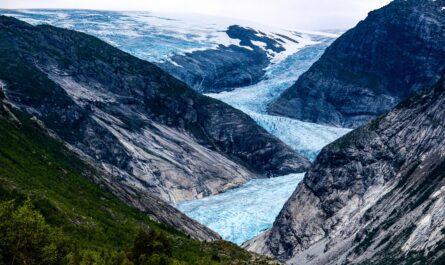
Their surfaces can appear blue because dense ice absorbs many wavelengths of visible light while allowing blue light to scatter and escape. In other cases, shadows make the openings appear nearly black.
Some crevasses are obvious, but others are concealed beneath snow bridges. A snow bridge may support a person’s weight temporarily before collapsing, which makes these openings particularly dangerous.
Seracs: Towers on the edge of collapse
Seracs are large blocks or towers of ice separated by deep fractures. They often form where the glacier breaks apart as it passes over steep terrain.
Some seracs rise several metres above the surrounding ice, while larger formations can be much taller. Their stability depends on the geometry of the ice, surrounding support, and changing stresses.
A collapsing serac can release enormous quantities of ice within seconds. Because the timing of a collapse is difficult to predict, climbers generally avoid travelling beneath unstable ice towers whenever possible.
Ice cliffs and overhanging formations
Some sections of an icefall develop steep walls or overhanging masses. These formations may form as the glacier breaks, melts, or moves around changes in the underlying terrain.
Overhanging ice can be especially hazardous because gravity continuously pulls it downward. A fracture may remain hidden until a section suddenly detaches.
Blue ice and frozen textures
Icefalls also reveal different layers and textures within a glacier. Compressed ice may appear deep blue, while snow-covered surfaces remain white.
Bubbles, sediment, and differences in density affect the appearance of the ice. These variations make icefalls attractive subjects for photographers, although the visual beauty of the formations can hide serious physical hazards.
5. Why Are Icefalls So Dangerous?
Icefalls are among the most challenging environments in glacial mountaineering because they combine unstable terrain, concealed openings, and the possibility of sudden collapse.
Their danger comes from several sources.
Falling ice
One of the greatest risks is the collapse of seracs or overhanging blocks. When a large formation breaks apart, the falling ice can create an avalanche of debris that travels downslope.
The collapse may occur without an obvious warning, leaving little time for anyone nearby to react.
Hidden crevasses
Fresh snow can cover cracks and create bridges that look like ordinary glacier surfaces. When a climber steps on one, they might not be aware that there is a deep aperture beneath.
If the bridge breaks, the person may fall into the crevasse, potentially suffering severe injuries or becoming trapped.
Difficult movement
An icefall’s surface may have uneven steps, unstable chunks, tight spaces, and sheer ice cliffs.To navigate such terrain, climbers may require certain gear and technical expertise.
Even experienced mountaineers can find progress slow and physically exhausting.
Avalanches and ice debris
When large amounts of ice collapse, the resulting debris can move rapidly down the slope. Depending on the terrain and snow conditions, collapsing ice may also trigger or contribute to an avalanche.
The danger is especially serious in narrow sections where there may be few safe places to escape.
Changing routes
An icefall route may become unusable after a collapse or the opening of a major crevasse. Fixed ladders, ropes, and other aids used by climbing teams may need to be repositioned.
This is why experienced guides and expedition teams assess conditions carefully and may abandon a crossing if the risks become unacceptable.
Important distinction: Icefalls are not necessarily the most dangerous part of every glacier. The level of risk depends on the particular glacier, route, season, and surrounding conditions. Nevertheless, heavily fractured icefalls are widely recognized as major hazards on some high-altitude climbing routes.
6. Famous Icefalls Around the World
Several well-known icefalls demonstrate the remarkable scale and complexity of glacial terrain.

1. Khumbu Icefall, Nepal
The Khumbu Icefall lies on the southern climbing route to Mount Everest. It is one of the best-known examples of an unstable icefall because the Khumbu Glacier descends through steep terrain below the Western Cwm.
Deep crevasses, towering seracs, and shifting ice create a demanding obstacle for climbers travelling toward higher camps. Expedition teams may install ladders and ropes, but these aids do not remove the underlying risks.
2. Fox Glacier, New Zealand
Fox Glacier descends from the Southern Alps toward a temperate rainforest environment. Its upper sections include steep and fractured ice terrain, reflecting the changing slopes and conditions along the glacier.
The glacier illustrates how ice movement and rugged mountain topography can create complex formations even in a landscape known for relatively mild coastal conditions.

3. Baltoro Glacier, Pakistan
The Baltoro Glacier is one of the major glaciers of the Karakoram. Its rugged surface, extensive debris cover, and complex movement provide examples of the challenges involved in travelling across large mountain glaciers.
Although not every fractured section of Baltoro is technically an icefall, the glacier demonstrates how steep terrain and variable ice flow can create difficult and changing passageways in high mountain environments.

4. Aletsch Glacier, Switzerland
The Aletsch Glacier is the largest glacier in the Alps. Its broad ice body displays the effects of gravity, valley geometry, and long-term glacier movement.
Its changing surface provides opportunities for scientific study and helps demonstrate how glaciers deform as they travel through mountainous landscapes.
These examples show that icefalls and heavily fractured glacier sections occur in different mountain regions. Their exact appearance and behaviour depend on local geography, climate, and the movement of the ice.
7. The Role of Icefalls in Glacier Movement
Although icefalls may appear destructive, they are a natural part of how many glaciers move through steep mountain environments.
Glaciers are driven by gravity. Their ice deforms under pressure and, in some circumstances, slides over the underlying bedrock. When the ground beneath the glacier changes elevation sharply, the ice must adapt to the new conditions.
An icefall forms where this adjustment creates intense deformation and fracturing.
As ice passes through the broken section, some fractures may close or become buried, while others widen. Ice blocks may rotate, collapse, or be carried downstream. Farther along the glacier, the surface may gradually become less fractured as the slope becomes gentler.
This process redistributes ice through the glacier system. The icefall itself does not generate the glacier’s movement; rather, it is a visible consequence of that movement interacting with steep terrain.
Scientists can study these formations to better understand how stress develops inside glaciers and how different parts of the ice respond to changes in slope and flow speed.
8. How Scientists Study Icefalls
Studying an icefall presents a challenge because its unstable surface can make direct observation dangerous. Researchers therefore combine field measurements with remote sensing and other scientific techniques.
Satellite imagery
Satellites allow scientists to observe glacier surfaces across large areas. By comparing images taken at different times, researchers can identify changes in crevasses, ice formations, and glacier boundaries.
Satellite observations are especially valuable in remote mountain regions where frequent field visits are difficult.
GPS measurements
Scientists may use GPS equipment to track the movement of selected points on a glacier. These measurements help reveal how quickly different sections of the ice are travelling and how their movement changes over time.
In suitable research settings, this information can help identify areas experiencing rapid deformation.
Drones and aerial photography
Drones can capture detailed images of accessible or carefully surveyed glacier sections. These images help researchers map crevasses, measure surface changes, and construct three-dimensional models.
However, drone flights require careful planning because mountain winds, poor visibility, and falling ice can create operational hazards.
Remote sensing and radar
Some radar systems can help measure surface movement or investigate aspects of a glacier’s structure. Researchers may combine radar observations with optical imagery and field measurements to develop a more complete understanding of the ice.
These methods allow scientists to investigate changing glacier conditions without placing people directly in every hazardous area.
9. Do Climate Change and Global Warming Affect Icefalls?
Climate change affects glaciers around the world, but its influence on an individual icefall is complex. It is important to distinguish between changes that affect the glacier as a whole and the mechanical processes that create fractures on steep slopes.
Rising temperatures can increase surface melting and influence how much snow accumulates and survives each year. In many mountain regions, glaciers are losing mass as ice loss exceeds the amount replaced by snowfall.
These changes can alter glacier thickness, surface elevation, and the position of the ice relative to the underlying terrain. As the geometry of a glacier changes, the distribution of stress within it can also change.
For example, thinning ice may expose previously covered bedrock or alter the shape of a steep section. Such changes can influence how fractures develop and where unstable formations occur.
Meltwater may also enter crevasses and affect local ice conditions. However, the effect varies according to temperature, water pathways, glacier structure, and other factors.
It would be misleading to claim that global warming always makes every icefall more unstable. Some icefalls may experience changing patterns of fracturing or collapse, while others respond differently depending on their location and physical characteristics.
Scientists therefore monitor glaciers over time to determine how changing environmental conditions affect their movement and structure.
The broader concern is that continued glacier retreat can affect downstream water supplies, mountain ecosystems, and communities that depend on seasonal meltwater. Icefalls are one visible part of a much larger glacial system responding to environmental change.
10. Icefalls and Mountaineering: A Test of Skill and Preparation
For mountaineers, crossing an icefall requires careful preparation, technical knowledge, and constant attention to changing conditions.
On some major climbing routes, expedition teams establish passages through icefalls using ropes, ladders, and marked routes. These passages can make movement more manageable, but they cannot eliminate the possibility of falling ice or hidden crevasses.
Experienced climbers and guides consider several factors before entering such terrain:
- Route assessment: Identifying known crevasses, unstable seracs, and possible alternative passages.
- Weather conditions: Considering snowfall, temperature, visibility, and other conditions that may influence safety.
- Technical equipment: Using appropriate ropes, harnesses, helmets, and other mountaineering equipment.
- Team communication: Ensuring that members understand the route, procedures, and emergency plans.
- Timing and exposure: Limiting unnecessary time beneath unstable ice and avoiding areas where safe passage cannot be established.
Even with extensive preparation, an icefall remains a natural environment that cannot be controlled completely.
Climbers should not attempt to cross an unfamiliar icefall without suitable training, equipment, and qualified professional guidance. Photographs and online route descriptions cannot reliably reveal current conditions on the ice.
11. Why Icefalls Are So Fascinating to Photographers and Nature Lovers
Icefalls attract photographers, scientists, and travellers because they reveal a side of glaciers that is rarely visible in smoother landscapes.
The contrast between brilliant white snow, translucent blue ice, deep shadows, and jagged formations creates striking patterns. From a safe viewpoint, these features can make an icefall look like a frozen city filled with towers, corridors, and broken walls.
Photographers often focus on the scale of the formations, the relationship between the ice and surrounding mountains, and the changing light across the glacier surface.
Early or late daylight may emphasize the texture of the ice, while shadows can reveal the depth of crevasses and the shape of seracs.
However, visitors should remember that an icefall is not a static attraction. The same forces that make it beautiful also make it potentially dangerous. Safe viewing locations, authorized trails, and guidance from local professionals are essential when visiting glacial areas.
For those who cannot travel to remote mountain regions, satellite images, scientific photography, and documentary footage offer ways to explore these remarkable landscapes without entering hazardous terrain.
12. What Happens When an Icefall Collapses?
Icefall collapses occur when sections of fractured ice lose their support and break away. The scale of these events varies considerably, from the fall of a relatively small block to the collapse of a large serac.
A collapse may be influenced by gravity, changes in internal stress, the weakening of supporting ice, or the continued movement of the glacier.
When a large section falls, it can produce a cascade of broken ice that travels down the slope. The debris may accumulate on the glacier surface, where it can be carried farther downhill or gradually broken into smaller pieces.
In some circumstances, a collapse can also trigger secondary events, such as an avalanche or further ice failures.
These events demonstrate why icefalls should not be treated as predictable structures. Researchers can monitor movement and identify some signs of instability, but forecasting the exact time of an individual collapse remains difficult.
The consequences depend on the amount of ice involved, the slope, the surrounding terrain, and whether people or infrastructure are exposed.
13. Icefall vs. Glacier vs. Iceberg: What Is the Difference?
These three terms describe different features of the world’s frozen environments.
| Feature | Meaning | Main characteristic |
|---|---|---|
| Glacier | A large body of ice formed from accumulated snow that moves under gravity | Flows slowly over land |
| Icefall | A steep, fractured section of a glacier | Contains intense deformation, crevasses, and often seracs |
| Iceberg | A mass of ice that has broken away from a glacier or ice shelf and floats in water | Drifts in a sea, lake, or other body of water |
A glacier can contain one or more icefalls, depending on the shape of the landscape beneath it. An iceberg, by contrast, is a detached mass of ice that floats in water.
The distinction is important because an icefall is not a separate glacier or a floating ice formation. It is a section of a glacier where steep terrain and ice movement create an unusually broken surface.
14. What Can Icefalls Teach Us About the Natural World?
Icefalls reveal how powerful natural forces can reshape a landscape without producing an obvious change in the surrounding mountains.
Their fractures show how stress accumulates inside ice. Their moving blocks reveal the influence of gravity, while their changing surfaces demonstrate the continuous relationship between glaciers and the terrain beneath them.
They also remind us that a glacier is a dynamic system rather than a permanent feature of the landscape.
The study of icefalls contributes to wider research into glacier behaviour, mountain hazards, and environmental change. Observations from these environments can help scientists improve their understanding of ice movement and identify areas that deserve closer monitoring.
Beyond their scientific value, icefalls encourage a deeper appreciation of the complexity of Earth’s frozen regions. Their dramatic appearance is a reminder that even landscapes that seem motionless can contain powerful and constantly changing processes.
Conclusion: The Unpredictable Beauty of an Icefall
An icefall is one of the most dramatic and structurally complex features of a glacier. Formed when moving ice travels over steep or uneven terrain, it develops into a landscape of deep crevasses, towering seracs, fractured ridges, and unstable ice blocks.
Its chaotic appearance reflects the forces working inside the glacier. Gravity pulls the ice downhill, differences in flow speed create stress, and fractures develop as the ice adjusts to the changing landscape. The result is a constantly evolving environment in which individual formations can shift or collapse.
For scientists, icefalls offer valuable insights into glacier dynamics and the effects of changing environmental conditions. For mountaineers, they represent serious obstacles that demand technical ability, careful planning, and respect for natural hazards. For photographers and nature lovers, they reveal the extraordinary beauty hidden within the world’s frozen mountains.
Perhaps the most important lesson is that icefalls combine beauty with uncertainty. Their towering structures and brilliant blue crevasses may appear frozen in time, but they are part of a moving system that never completely stands still.
Understanding icefalls allows us to appreciate not only their dramatic appearance but also the powerful processes that shape glaciers and the mountain environments around them.