 by
Glaciers are powerful natural features that preserve evidence of Earth’s changing climate. These enormous masses of ice develop when snow accumulates over many years, compresses into dense ice, and begins moving under its own weight. Although glaciers are commonly associated with Antarctica, the Himalayas, and the Arctic, they have also played an important role in shaping the mountains of Australia and Oceania.
The region presents an unusual contrast. Australia’s mainland no longer has active glaciers, but its mountains contain landforms created by ancient ice. New Zealand, by contrast, still has numerous glaciers in the Southern Alps, including the famous Franz Josef and Fox glaciers. Farther north, the high mountains of western New Guinea have supported tropical glaciers despite their location close to the equator.
These differences make Australia and Oceania valuable for understanding how glaciers respond to elevation, snowfall, rainfall, temperature, and changing weather patterns. They also illustrate the consequences of global warming, which has contributed to widespread glacier retreat.
Exploring the glaciers of this region means looking at both the past and the present: the ancient ice that shaped Australia’s mountains, the glaciers that continue to flow through New Zealand’s valleys, and the increasingly fragile ice remnants near Puncak Jaya.
1. Understanding Glaciers in Australia and Oceania
A glacier is not simply a permanent patch of snow. It is a body of ice that forms when snow survives successive seasons, accumulates, and gradually compresses. As the ice becomes thick enough, gravity causes it to deform and move.
Glaciers generally develop where snowfall and snow accumulation exceed the amount of ice lost through melting, evaporation, and other processes over an extended period. Cold temperatures are essential, but precipitation is equally important. A high mountain may remain relatively ice-free if it receives too little snow, even when its temperatures are low.
Australia and Oceania contain several different glacier environments.
- Australia: The mainland has no recognised modern glaciers, but its highlands preserve evidence of past glaciation.
- New Zealand: Glaciers remain in the Southern Alps, particularly in the mountainous South Island.
- Western New Guinea: Small tropical glaciers have survived near the highest peaks of the Sudirman Range in present-day Indonesia’s Papua region.
- Nearby Pacific islands: Many have volcanic mountains, but most lack the combination of elevation and climate needed to sustain glaciers today.
The region demonstrates that latitude alone does not determine whether glaciers can exist. Extremely high mountains near the equator can support ice, while mountains much farther south may remain free of glaciers if their elevations and snowfall are insufficient.
2. Australia’s Ancient Glaciers: A Frozen Past
Australia is often described as a dry and relatively warm continent, so its glacial history may seem surprising. However, during colder periods of the Pleistocene, parts of southeastern Australia experienced conditions that allowed small mountain glaciers to form.
The Pleistocene began approximately 2.58 million years ago and ended around 11,700 years ago. Earth’s climate underwent numerous glacial and interglacial cycles during this time. Temperatures fell during glacial periods, allowing ice sheets and mountain glaciers to expand in suitable environments.
In mainland Australia, the most important evidence of former mountain glaciers is found in the Australian Alps, particularly around Mount Kosciuszko.
Where did Australian glaciers form?
The highest parts of the Australian Alps experienced colder conditions during past ice ages. Snow accumulated in sheltered mountain basins, and small glaciers developed in favourable locations.
These glaciers were much smaller than the enormous ice sheets that covered parts of the Northern Hemisphere. Nevertheless, they were powerful enough to reshape the landscape.
Glacial erosion can produce distinctive landforms, including bowl-shaped depressions called cirques, rocky ridges known as moraines, and valleys modified by moving ice. These features remain visible long after the ice has disappeared.
What happened to Australia’s glaciers?
As the climate warmed after the last major glacial period, the glaciers retreated and eventually vanished from mainland Australia. Their disappearance left behind rocky terrain, lakes, and other features that scientists use to reconstruct the region’s climatic history.
Today, the Australian Alps are important for studying how environments respond to changing temperatures. Their former glaciers provide evidence that Australia’s mountain climate was once considerably colder than it is now.
It is important to distinguish between modern glaciers and glacial landforms. A landscape may contain clear evidence of ancient ice without having any active glaciers at present.
3. New Zealand: The Centre of Modern Glacier Activity in Oceania
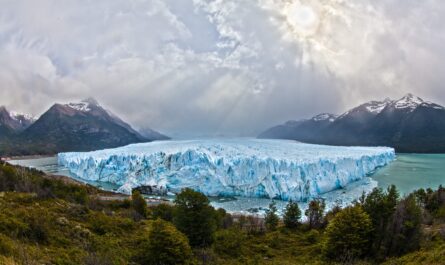
New Zealand is the most prominent location for present-day glaciers in the region. Its South Island contains the Southern Alps, a mountain chain that rises steeply from the surrounding landscape.
The mountains receive substantial precipitation from moist air arriving from the Tasman Sea. When this moisture reaches high elevations, it can produce heavy snowfall. In sufficiently cold areas, snow accumulates and gradually becomes glacial ice.
The combination of high mountains, precipitation, and cold conditions allows numerous glaciers to survive.
Why are New Zealand’s glaciers important?
New Zealand’s glaciers shape valleys, feed rivers, influence mountain ecosystems, and attract visitors from around the world. They also provide researchers with valuable evidence about changes in regional climate.
Many glaciers have retreated over recent decades, although their individual behaviour varies. Changes in snowfall, temperature, ice flow, and the terrain surrounding each glacier influence how quickly it loses ice.
The Southern Alps are particularly useful for climate research because glacier changes can be compared with meteorological records, satellite observations, and historical photographs.
4. Franz Josef Glacier: An Icon of the West Coast
<AsyncImageGroup query={[“Franz Josef Glacier New Zealand aerial ice valley”,”Franz Josef Glacier Southern Alps terminal valley landscape”,”Franz Josef Glacier New Zealand mountain ice aerial view”]} aspectRatio=”5:4″ layout=”bento” />
Franz Josef Glacier, known in Māori as Kā Roimata o Hine Hukatere, lies on New Zealand’s South Island near the West Coast. It descends from the Southern Alps toward a comparatively low elevation, creating a striking contrast between the icy upper mountain environment and the greener landscape below.
The glacier has long been a major attraction for visitors interested in mountain scenery and glacial processes.
Its past and present
Franz Josef Glacier has experienced periods of advance and retreat throughout its history. Its behaviour is influenced by temperature, snowfall, precipitation, and the movement of ice from higher elevations.
During parts of the twentieth century, the glacier advanced despite the broader pattern of warming. Such advances can occur when changes in snowfall and ice flow temporarily outweigh losses at the terminus. They do not necessarily indicate that a glacier is unaffected by long-term climate change.
In recent decades, Franz Josef has experienced substantial retreat and changes in its lower reaches. The terminus and surrounding terrain can change significantly over relatively short periods, making older photographs and visitor descriptions unreliable guides to current conditions.
Why it matters
Franz Josef Glacier demonstrates that glacier behaviour can fluctuate from year to year while still following a longer-term trend of ice loss.
It also illustrates the challenges of glacier tourism. Routes and viewing areas may change as the ice retreats, and access conditions depend on local safety assessments. Visitors should follow current guidance from New Zealand’s Department of Conservation and local operators rather than assuming they can safely walk directly onto the glacier.
5. Fox Glacier: A Changing Landscape in Westland
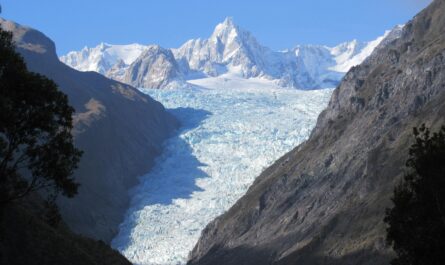
Fox Glacier, known in Māori as Te Moeka o Tuawe, is another well-known glacier on New Zealand’s West Coast. Like Franz Josef, it descends from the high Southern Alps into a landscape of forested slopes and mountain valleys.
The glacier is part of a dynamic environment where snowfall at higher elevations supplies ice that gradually moves downhill.
What makes Fox Glacier distinctive?
Fox Glacier is notable for its dramatic mountain setting and its relationship with the surrounding landscape. Its lower reaches have historically been accessible from relatively low elevations compared with glaciers in many other parts of the world.
However, the glacier’s terminus has retreated substantially over recent decades. Its position, the shape of the valley, and the accessibility of nearby viewpoints have changed over time.
The glacier’s history demonstrates that a glacier can remain visually impressive while losing substantial amounts of ice. A large volume of ice at higher elevations does not guarantee that the lower terminus will remain in the same place.
Visiting responsibly
The area surrounding Fox Glacier offers opportunities to learn about glacial landscapes, but access restrictions can change with weather, flooding, rockfall, and instability around the glacier front.
Visitors should use approved viewing locations, check official information, and avoid entering restricted areas. The glacier is a natural system in motion, not a static attraction.
6. Tasman Glacier: New Zealand’s Largest Glacier
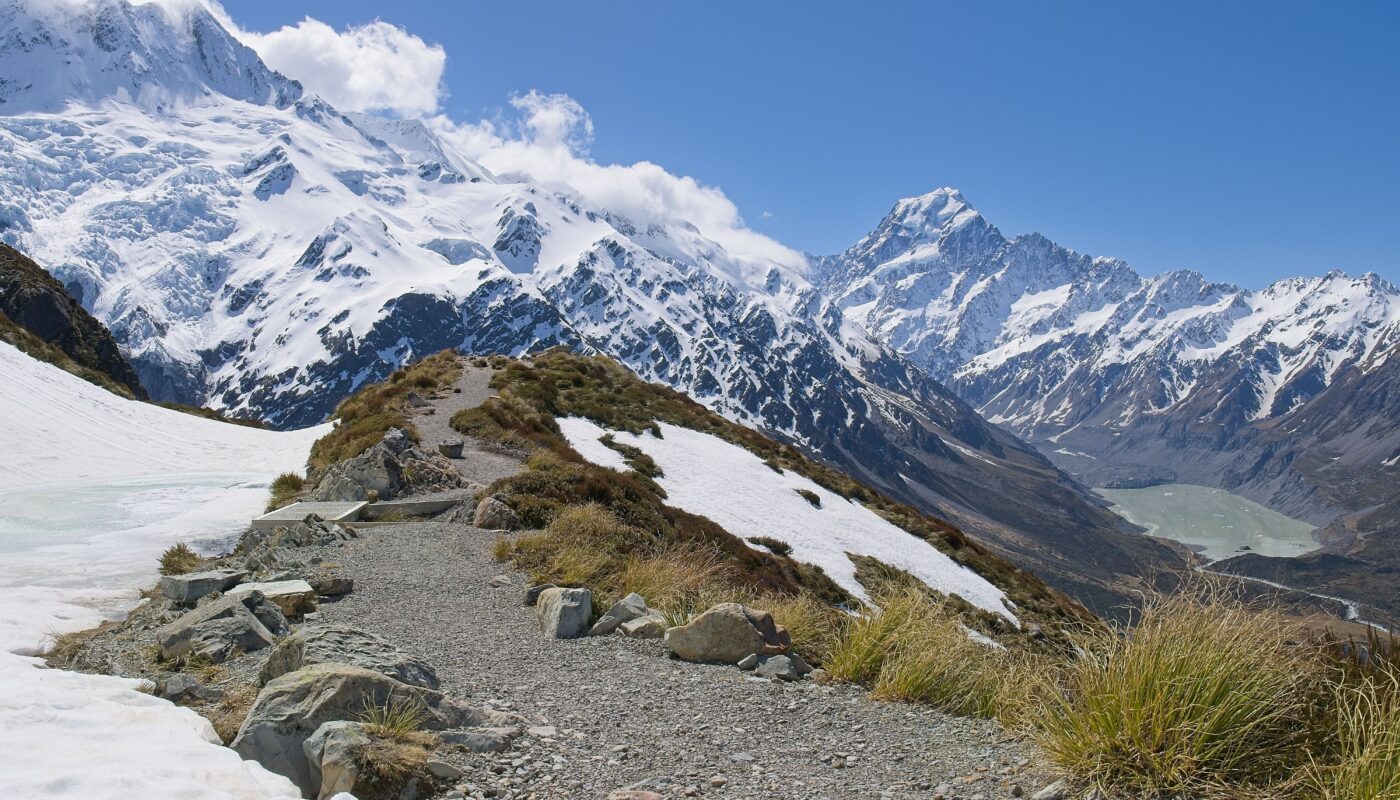
Tasman Glacier lies on the eastern side of the Southern Alps within Aoraki/Mount Cook National Park. It is generally recognised as New Zealand’s longest glacier and is an important example of a large valley glacier.
Compared with the more accessible West Coast glaciers, Tasman Glacier occupies a broad alpine valley and is associated with a landscape of rock debris, meltwater, and glacial lakes.
How Tasman Glacier has changed
Tasman Glacier has experienced substantial thinning and retreat. As the ice has withdrawn, a lake has developed and expanded at its lower end. The presence of water near the terminus can influence how the glacier loses ice, including through calving, when chunks of ice break away into the lake.
This process shows why glaciers do not all respond to warming in exactly the same way. The topography beneath the ice and the conditions at the glacier front can accelerate or slow changes.
Why researchers study it
Tasman Glacier offers a useful opportunity to examine the interaction between ice, water, and mountain landscapes. Researchers can study changes in ice thickness, lake development, glacier movement, and the transport of sediment.
Its retreat also affects the surrounding scenery and the experiences available to visitors. The landscape visible today may differ significantly from images taken several decades ago.
7. Other Important Glaciers of New Zealand
Although Franz Josef, Fox, and Tasman are among the best-known glaciers, they are only part of New Zealand’s wider glacial landscape.
Hooker Glacier
Hooker Glacier lies near Aoraki/Mount Cook and is associated with a mountain lake at its lower end. It has experienced significant changes as its terminus has retreated and the lake has developed.
The area offers a useful example of how glacier retreat can transform the landscape by exposing new terrain and creating or enlarging bodies of meltwater.
Murchison Glacier
Murchison Glacier is another glacier in the Aoraki/Mount Cook region. Its ice, surrounding rock debris, and alpine setting provide opportunities for studying the behaviour of mountain glaciers.
Like other glaciers in the Southern Alps, its long-term condition depends on the balance between accumulation at higher elevations and ice loss farther down the valley.
What these glaciers tell us
Together, New Zealand’s glaciers show that regional warming does not produce identical outcomes everywhere. Elevation, precipitation, shading, valley shape, and the presence of water at the terminus all influence glacier behaviour.
Monitoring multiple glaciers helps researchers distinguish broad climatic trends from the local factors that affect individual ice bodies.
8. Tropical Glaciers in Western New Guinea
<AsyncImageGroup query={[“Puncak Jaya Carstensz Pyramid mountain tropical glacier satellite landscape”,”Puncak Jaya Papua Indonesia snow ice summit mountain”,”Carstensz Pyramid West Papua mountain ice aerial view”]} aspectRatio=”5:4″ layout=”bento” />
One of the most unusual glacier environments in Oceania is found near Puncak Jaya in western New Guinea, within Indonesia’s Papua region.
Puncak Jaya rises to approximately 4,884 metres above sea level. Its exceptional elevation allows ice to survive in a tropical environment close to the equator.
These glaciers are scientifically important because they are among the last remaining tropical glaciers in the western Pacific region.
A history of major ice loss
Historical evidence indicates that the glaciers around Puncak Jaya once covered a much larger area. During colder periods, ice extended across broader sections of the surrounding mountains. Over time, warmer conditions caused the glaciers to shrink.
A major study published in The Cryosphere in December 2025 used high-resolution satellite imagery and historical records to reconstruct glacier changes. It estimated that the mapped glacier area fell from approximately 19.3 square kilometres around 1850 to about 0.165 square kilometres in 2024.
That represents a loss of more than 99% of the mapped area over the period studied. Between 2018 and 2024 alone, the remaining area decreased by approximately 65%. Researchers warned that the surviving glaciers could disappear around 2030 if the observed retreat rate continues. This is a projection, not a guaranteed date. <Cite refs={[“turn731918search0″,”turn731918search2”]}/>
Why are tropical glaciers so vulnerable?
Tropical glaciers experience relatively little seasonal temperature variation compared with glaciers in polar regions. Their survival depends heavily on maintaining a suitable balance between snowfall, melting, and other forms of ice loss.
When temperatures rise, the elevation at which snow and ice can persist may shift upward. Because mountain summits provide limited space, a glacier cannot retreat indefinitely toward higher ground.
The glaciers of Puncak Jaya illustrate this vulnerability. As their ice cover shrinks, the remaining fragments become increasingly restricted to the highest parts of the mountain.
9. Why Are the Region’s Glaciers Retreating?
The causes of glacier retreat differ between individual locations, but several processes are particularly important across Australia and Oceania.
Rising air temperatures
Warmer air increases the potential for melting, especially during periods when temperatures remain above freezing for longer. It can also raise the elevation of the snowline, reducing the area where snow accumulates and survives throughout the year.
When melting consistently exceeds accumulation, a glacier loses mass.
Changes in snowfall
Glaciers need a continuing supply of snow. If snowfall decreases, or if more precipitation falls as rain rather than snow, the glacier may struggle to replace the ice it loses.
In New Zealand, changes in precipitation and regional weather patterns can complicate the relationship between warming and glacier retreat. The exact influence varies from one glacier to another.
Changes in glacier dynamics
A glacier responds not only to the weather but also to its own physical structure. Ice thickness, valley shape, bedrock, and the presence of a lake can influence the speed of retreat.
For example, calving into a lake may accelerate ice loss at a lake-terminating glacier. By contrast, a glacier resting on a stabilising section of bedrock may respond differently even under similar climatic conditions.
Long-term climate change
Natural climate variability has caused glaciers to advance and retreat throughout Earth’s history. However, the widespread retreat observed across many regions in recent decades is consistent with the influence of human-caused global warming.
The region’s glaciers therefore provide important evidence of how rising temperatures affect environments that are already close to the limits for permanent ice.
10. Environmental Consequences of Glacier Loss
Glacier retreat affects more than mountain scenery. It can influence freshwater supplies, ecosystems, sediment movement, and natural hazards.
Freshwater and river systems
Glaciers store water in frozen form and release it through melting. Their runoff can contribute to rivers and streams, particularly during warmer periods.
As glaciers shrink, runoff patterns may change. In the short term, increased melting can raise water flows under some conditions. Over the longer term, continued loss of ice reduces the amount of frozen water available for release.
The effects depend on the size of the glacier, the local climate, and the importance of glacial meltwater within the wider river system.
Ecosystem changes
As glaciers retreat, they expose bare rock, sediment, and new land. Plants gradually colonise some of these surfaces, while local wildlife may respond to changes in water conditions and habitat availability.
Newly exposed ground can take many years to develop mature soils and vegetation. Ecological change is therefore often gradual and varies with altitude, moisture, and the surrounding environment.
Natural hazards
Glacier retreat can create or enlarge lakes near glacier fronts. Depending on the terrain and the stability of surrounding slopes, these lakes can introduce hazards such as sudden water releases, flooding, or slope failure.
Not every glacial lake is dangerous, and risk must be assessed at the individual site. Nevertheless, monitoring changing glacier environments is important for protecting nearby communities and visitors.
Tourism and local economies
Glaciers are major attractions in parts of New Zealand. Retreat can change the views, walking routes, and types of activities available to visitors.
Tourism operators and local authorities must adapt as access conditions change. Clear information, responsible visitor management, and investment in alternative experiences can help destinations respond to these transformations.
11. How Scientists Monitor Glaciers Today
Understanding glacier change requires more than comparing photographs. Scientists combine several methods to measure how ice is changing.
Satellite imagery allows researchers to map glacier boundaries over large areas and compare images taken years apart.
Aerial photography and drones can provide detailed views of glacier fronts, surface cracks, and surrounding terrain.
GPS measurements help track the position of glacier features and, in suitable studies, estimate how quickly ice is moving.
Elevation surveys reveal whether a glacier’s surface is rising or lowering. When combined with information about glacier area, these measurements help researchers estimate changes in ice volume.
Weather stations and field observations provide information about temperature, snowfall, rainfall, and other conditions that influence glacier mass balance.
These methods are especially important for remote glaciers in western New Guinea, where difficult access makes continuous field measurements challenging. The 2025 Puncak Jaya study demonstrates how modern satellite imagery can be combined with historical maps and records to reconstruct long-term change. <Cite refs={[“turn731918search0″,”turn731918search2”]}/>
12. What Does the Future Hold?
The future of glaciers in Australia and Oceania will depend partly on global emissions and partly on the local geography and climate of each region.
Australia’s mainland is not expected to regain its former mountain glaciers under present conditions. Its ancient glacial landscapes will remain important records of past climate, even though the ice itself has disappeared.
In New Zealand, many glaciers are likely to continue losing mass as the climate warms. Individual glaciers may fluctuate or temporarily advance, but sustained warming creates pressure toward long-term ice loss. The timing and scale of future changes will depend on emissions, snowfall, regional weather, and the characteristics of each glacier.
The outlook for Puncak Jaya is especially concerning. The remaining ice is already extremely limited, and recent research suggests that disappearance could occur around 2030 if current retreat rates persist. Continued observations will be needed to assess how quickly the final ice remnants change.
Reducing greenhouse gas emissions is essential for limiting future warming. Although some glacier changes will continue because of past warming, the extent of future ice loss is influenced by the climate pathway the world follows.
Conclusion
The glaciers of Australia and Oceania tell a remarkable story of ancient ice, surviving mountain glaciers, and rapid environmental change. Australia’s mainland preserves evidence of glaciers that disappeared after earlier ice ages. New Zealand continues to support glaciers such as Franz Josef, Fox, and Tasman, although many have retreated and become thinner. In western New Guinea, the tropical glaciers of Puncak Jaya have shrunk to a tiny fraction of their former extent.
These different environments demonstrate that glaciers are shaped by more than latitude. Elevation, snowfall, temperature, bedrock, and the presence of lakes all influence their survival.
Their retreat has implications for freshwater systems, mountain ecosystems, tourism, and scientific understanding of global climate change. By monitoring glacier boundaries, thickness, and movement, researchers can document these transformations and improve predictions of what may happen next.
The region’s glaciers are therefore more than beautiful natural landmarks. They are valuable records of Earth’s climatic past and important indicators of its changing future.