by
by The Arctic is one of the most extraordinary environments on Earth. Far beyond the world’s major cities, a vast landscape of frozen seas, snow-covered mountains, polar deserts, and enormous ice masses stretches around the northern part of the planet. Among its most remarkable features are glaciers, which cover large portions of islands and high-latitude mountain ranges.
Arctic glaciers are much more than beautiful frozen landscapes. They are constantly moving bodies of ice that shape mountains, carve valleys, transport sediment, store freshwater, and record information about past environmental conditions. They also respond to changes in temperature and snowfall, making them valuable indicators of what is happening to the Arctic climate.
Three regions provide especially fascinating examples of Arctic glaciation: Svalbard, Arctic Canada, and Arctic Russia. Each contains a distinctive combination of ice caps, mountain glaciers, outlet glaciers, and coastal ice. Although they share the same broad polar environment, their glaciers behave differently because of variations in geography, snowfall, temperature, ocean conditions, and terrain.
Exploring these three regions offers a remarkable opportunity to understand both the beauty and the changing nature of the Arctic.
What Exactly Is an Arctic Glacier?
A glacier begins with snow rather than ice.
In places where temperatures remain cold enough, winter snow survives through the summer. Additional snow accumulates year after year, gradually compressing older layers beneath it. Over long periods, the pressure transforms snow into dense glacial ice.
Eventually, the accumulated ice becomes heavy enough to flow.
This movement can be extremely slow, but it is continuous. A glacier may move only a few meters in a year, while some fast-flowing glaciers can travel much farther.
As glaciers move, they interact with the land beneath and around them. They can widen valleys, scrape rocks from mountainsides, transport enormous quantities of sediment, and create distinctive landscapes.
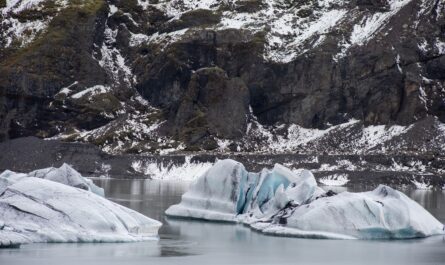
When a glacier reaches the ocean, its front may break apart through a process called calving. Large pieces of ice then float away as icebergs.
The balance between snow accumulation and ice loss determines whether a glacier grows or shrinks. Scientists call this its mass balance.
When a glacier loses more ice than it gains, it has a negative mass balance.
Svalbard: An Arctic World of Mountains and Ice
Svalbard is a remote Norwegian archipelago located in the Arctic Ocean between mainland Norway and the North Pole. Its combination of mountains, deep fjords, rocky valleys, and extensive ice makes it one of the most recognizable glacial landscapes in the high Arctic.
The largest island, Spitsbergen, contains numerous glaciers. Other islands also contain substantial areas of permanent ice.
Svalbard is particularly valuable for glacier research because its ice is spread across many different environments. Some glaciers are located high in the mountains, while others flow toward the sea.
The region is also home to scientific stations that allow researchers to make long-term observations.
Austfonna: One of Svalbard’s Great Ice Caps
Austfonna is one of the most impressive ice-covered areas in Svalbard. It occupies a large part of Nordaustlandet and forms a broad ice cap from which several glaciers flow outward.
An ice cap differs from a typical valley glacier because it covers a much wider area rather than being confined to one mountain valley.
Austfonna’s enormous frozen surface is influenced by snowfall, summer temperatures, wind, and interactions between its outlet glaciers and the surrounding environment.
Some of its glaciers extend toward the coast, making the ice cap part of the dynamic connection between the mountains and the Arctic Ocean.
Its size and long-term changes make Austfonna an important subject for climate and glaciological research.
Kongsfjorden’s Glaciers
The area surrounding Kongsfjorden in western Spitsbergen provides another excellent example of Svalbard’s glacial environment.
Several glaciers descend toward the fjord, creating dramatic scenery where ice-covered mountains meet dark Arctic water.
Kongsvegen is particularly important because it has been monitored for many years.
Long-term measurements allow scientists to compare snowfall, summer melting, ice thickness, and glacier movement over time. These observations are more useful than looking at a single season because glaciers naturally experience annual variations.
The Kongsfjorden area also demonstrates how glacier retreat can change a fjord ecosystem. As glaciers move backward, newly exposed land becomes available for colonization by plants and microorganisms, while freshwater and sediment flows into the fjord change.
Why Svalbard’s Glaciers Matter
Svalbard’s glaciers are important both scientifically and environmentally.
They provide evidence of changes occurring in the Arctic atmosphere and ocean. Their retreat can also influence coastal ecosystems and the amount of freshwater entering fjords.
Because many glaciers are relatively accessible compared with the enormous ice masses of other Arctic regions, researchers can combine field observations with satellite measurements.
Svalbard therefore serves as a natural laboratory for understanding how high-latitude glaciers respond to environmental changes.
Arctic Canada: A Continent of Ice-Covered Islands
Travel east across the Arctic Ocean and another enormous glacial landscape appears across Canada’s northern islands.
The Canadian Arctic Archipelago contains some of the largest concentrations of glacier ice outside Greenland and Antarctica.
Large ice caps cover parts of islands such as Devon, Ellesmere, Axel Heiberg, and others.
The landscape is extremely remote. Many glaciers are surrounded by rugged terrain and are accessible only by aircraft or specialized expeditions.
Because direct visits are difficult, satellites have become an essential tool for monitoring Canadian Arctic glaciers.
Scientists can use satellite observations to determine how far a glacier has retreated, whether its surface is becoming thinner, and how quickly its outlet glaciers are moving.
Devon Ice Cap
The Devon Ice Cap is one of the most important glacial features in Arctic Canada.
Located on Devon Island, it covers a substantial area and feeds several glaciers extending toward lower terrain and the coast.
The ice cap provides researchers with an opportunity to examine how a large Arctic ice mass responds to changing atmospheric conditions.
Measurements of snow accumulation and surface melting can be combined with observations of ice thickness and movement.
Over the long term, changes in the Devon Ice Cap contribute to the broader scientific understanding of Arctic ice loss.
The landscape around the ice cap also demonstrates the power of glaciers to reshape the terrain. Valleys, ridges, exposed rock, and sediment deposits reveal the effects of repeated glacial activity over thousands of years.
Meighen Ice Cap
Meighen Island, located in the Canadian High Arctic, is home to the smaller but scientifically valuable Meighen Ice Cap.
Its remote location makes it difficult to visit regularly, but it has been included in long-term glacier monitoring programs.
The ice cap is useful because scientists need observations from multiple locations to understand regional patterns.
One glacier can gain or lose ice for local reasons, while a larger collection of glaciers can reveal broader climate trends.
Meighen therefore forms one piece of the much larger puzzle of Arctic glacier change.
Melville South Ice Cap
Another notable ice mass is the Melville South Ice Cap.
Situated in the High Arctic, it experiences the extreme seasonal conditions characteristic of the region. Winter temperatures can remain exceptionally low, while summer provides a short period during which melting can occur.
The difference between winter accumulation and summer loss determines its annual mass balance.
The glacier’s year-to-year changes demonstrate why scientists avoid drawing conclusions from a single season. A particularly snowy winter or unusually cool summer can temporarily reduce ice loss, while a warm summer can produce substantial melting.
Long records provide a much clearer picture.
What Makes Canadian Arctic Glaciers Special?
The Canadian Arctic contains an impressive mixture of enormous ice caps and smaller glaciers.
Many of these ice masses occupy landscapes where exposed rock, frozen valleys, and glacial ice exist side by side.
As glaciers retreat, areas that have been covered by ice for long periods can become exposed.
This can reveal:
- Newly uncovered rock
- Ancient sediment
- Meltwater channels
- Freshwater ponds
- Previously buried landscapes
- New areas for plants and microorganisms
In this way, glacier retreat can effectively create new landscapes.
However, this transformation also indicates that the Arctic environment is undergoing significant change.
Arctic Russia: A Vast and Remote Glacial Realm
The Russian Arctic is one of the least accessible glacial regions on the planet.
Its major glaciated areas include Novaya Zemlya, Severnaya Zemlya, and Franz Josef Land.
These remote islands are characterized by severe weather, long periods of darkness during winter, limited infrastructure, and enormous distances.
Despite the difficulties of reaching them, they are extremely important for Arctic research.
Satellites have become particularly valuable in this region because they allow scientists to monitor ice from space.
Images collected over many years can reveal whether glacier fronts are moving, retreating, or changing shape.
Novaya Zemlya and the Severny Island Ice Cap
Novaya Zemlya consists of two major islands separated by a narrow waterway.
The northern island, Severny Island, contains an enormous ice cap.
The Severny Island ice cap is one of the world’s largest ice caps by area and is among the most significant glacial features in the Russian Arctic.
Numerous outlet glaciers extend from the ice-covered interior toward the coast.
Where these glaciers meet the ocean, they can lose ice through calving as well as surface melting.
This combination makes coastal glaciers particularly sensitive to changes occurring both in the atmosphere and in surrounding seawater.
Severnaya Zemlya: Ice at the Edge of the Arctic Ocean
Severnaya Zemlya is an isolated archipelago located north of the Siberian mainland.
Several of its islands contain substantial ice-covered areas.
The landscape is stark and dramatic. Broad stretches of glacier ice descend toward rocky coastlines, while floating ice occupies the surrounding seas.
Because access is so difficult, researchers frequently depend on remote sensing to study the region.
Satellite technology can reveal changes that would be extremely difficult to document through repeated field expeditions.
Scientists can compare images from different years to determine whether ice margins are retreating or advancing and whether glacier surfaces are becoming thinner.
Franz Josef Land
Franz Josef Land is another extraordinary Russian Arctic archipelago.
It consists of numerous islands located far north in the Arctic Ocean. Glaciers and ice caps occupy significant portions of the landscape.
The islands provide an example of how glaciers interact with both mountains and coastlines.
Where ice approaches the ocean, calving can produce floating ice fragments and icebergs. Meanwhile, glacier movement continually modifies the underlying landscape.
The isolation of Franz Josef Land has also helped preserve a remarkably wild environment.
Why Are Arctic Glaciers Losing Ice?
The Arctic has experienced substantial warming, and glaciers are responding to those changes.
The most direct factor is rising air temperature.
When summer temperatures increase, more snow and ice can melt from the glacier surface.
If winter snowfall does not compensate for that loss, the glacier becomes smaller.
However, the process is more complicated than temperature alone.
Changing Snowfall
Snowfall is critical because snow represents new material added to a glacier.
A glacier experiencing increased snowfall may temporarily offset some of the effects of warmer temperatures.
This is why scientists measure both accumulation and melting.
Weather patterns can also vary significantly from year to year, creating temporary increases or decreases in glacier mass loss.
The Role of the Ocean
For glaciers that terminate in seawater, the ocean can play an important role.
Ocean temperatures influence the submerged portion of a glacier front.
If relatively warm seawater reaches the glacier, underwater melting may increase.
A glacier can also lose substantial amounts of ice when pieces break away from its front.
This process, known as calving, is especially important for tidewater glaciers.
Therefore, changes in Arctic glaciers are influenced by interactions among air, snow, land, ocean, and ice.
Why Glacier Loss Matters Beyond the Arctic
Arctic glacier retreat may occur in remote locations, but its consequences are not confined to the polar regions.
When land-based glaciers lose ice, some of that water eventually reaches the world’s oceans.
This contributes to global sea-level rise.
Glacier retreat can also modify freshwater systems, sediment transport, and coastal environments.
In some areas, rapid changes in ice-covered slopes can contribute to increased risks of landslides or unstable terrain.
Glaciers therefore form part of a much larger Earth system.
Glaciers as Natural Climate Records
One of the most fascinating properties of glaciers is their ability to preserve information about the past.
As snow accumulates, layers become compressed and buried. In suitable ice masses, these layers can preserve tiny particles and air bubbles from earlier periods.
Researchers can examine such material to investigate past atmospheric conditions.
Glacial records can provide evidence concerning:
- Ancient atmospheric composition
- Volcanic activity
- Dust levels
- Snowfall
- Temperature patterns
- Environmental changes
In this sense, glaciers can function like natural history books.
Their ice contains clues about environmental conditions that existed long before modern instruments began recording weather.
Svalbard vs. Arctic Canada vs. Russia
Although all three regions are part of the Arctic, their glacier landscapes have different characteristics.
Svalbard
Svalbard has numerous individual glaciers, ice caps, and tidewater glaciers distributed across a mountainous island landscape. Its glaciers are particularly valuable for field research and climate studies.
Arctic Canada
Canada is home to extensive ice caps spread across a huge archipelago. Its glaciers are highly remote and provide important information about changes in the High Arctic.
Arctic Russia
Russia contains enormous and isolated ice masses, particularly on Novaya Zemlya and other northern islands. Satellite observations are essential because many locations are extremely difficult to reach.
The Future of Arctic Glaciers
The future of Arctic glaciers will depend heavily on how temperatures, snowfall, ocean conditions, and atmospheric circulation evolve.
If warming continues, many glaciers are expected to experience further losses.
However, not every glacier will respond at exactly the same rate.
A glacier’s elevation, orientation, size, snowfall patterns, connection with the ocean, and surrounding terrain can all influence its behavior.
Some glaciers may temporarily stabilize, while others can experience rapid retreat.
This variation is one reason scientists monitor many glaciers rather than using a single location as a representative example of the entire Arctic.
Long-term measurements provide the clearest evidence of overall trends.
Why Arctic Glacier Research Is So Important
Studying glaciers in Svalbard, Arctic Canada, and Russia helps scientists understand more than the fate of individual ice masses.
These glaciers provide information about the Arctic climate system as a whole.
Researchers can compare measurements from different regions to determine how atmospheric warming, snowfall, ocean temperatures, and local geography interact.
Modern technology has made this research increasingly powerful.
Scientists can combine:
- Satellite imagery
- GPS measurements
- Aircraft surveys
- Weather observations
- Ice thickness measurements
- Snow studies
- Historical photographs
- Computer models
Together, these methods create a detailed picture of how Arctic glaciers are changing.
Visiting Arctic Glaciers Responsibly
For travelers fortunate enough to experience the Arctic, glaciers can be among the most memorable sights.
Svalbard is considerably more accessible to visitors than many Arctic Russian or Canadian glacier regions. Boat trips through fjords can provide views of glacier fronts, while guided expeditions can offer opportunities to see glacial landscapes from closer distances.
However, Arctic environments are fragile.
Visitors should:
- Follow local regulations
- Stay with qualified guides
- Avoid approaching unstable glacier fronts
- Never walk onto glacier ice without appropriate expertise
- Keep wildlife at a safe distance
- Avoid disturbing vegetation and geological features
- Minimize waste
- Respect protected areas
Responsible tourism can allow people to appreciate these landscapes without unnecessarily damaging them.
Final Thoughts
The glaciers of Svalbard, Arctic Canada, and Russia form one of the most extraordinary collections of frozen landscapes on Earth.
Svalbard combines dramatic mountains, fjords, outlet glaciers, and expansive ice caps. Arctic Canada contains vast ice-covered islands where enormous ice masses stretch across some of the world’s most remote terrain. Arctic Russia is home to immense and isolated glacial systems, including the great ice caps of Novaya Zemlya, Severnaya Zemlya, and Franz Josef Land.
Despite their differences, all three regions demonstrate that glaciers are dynamic parts of the planet rather than permanent blocks of ice.
They move, melt, calve, reshape landscapes, transport sediment, store freshwater, and preserve evidence of environmental history.
They are also highly sensitive to climate conditions. Changes in snowfall, air temperature, ocean conditions, and seasonal weather can alter the balance between ice accumulation and ice loss.
For this reason, Arctic glaciers are among the most important natural indicators of a changing climate.
Their future will influence not only the appearance of the far north but also freshwater systems, coastal environments, ecosystems, and global sea levels.
Svalbard, Arctic Canada, and Arctic Russia therefore offer more than spectacular scenery. Together, they provide a window into the changing Arctic and an opportunity to understand how one of Earth’s most remote environments is responding to a rapidly changing world.