 by
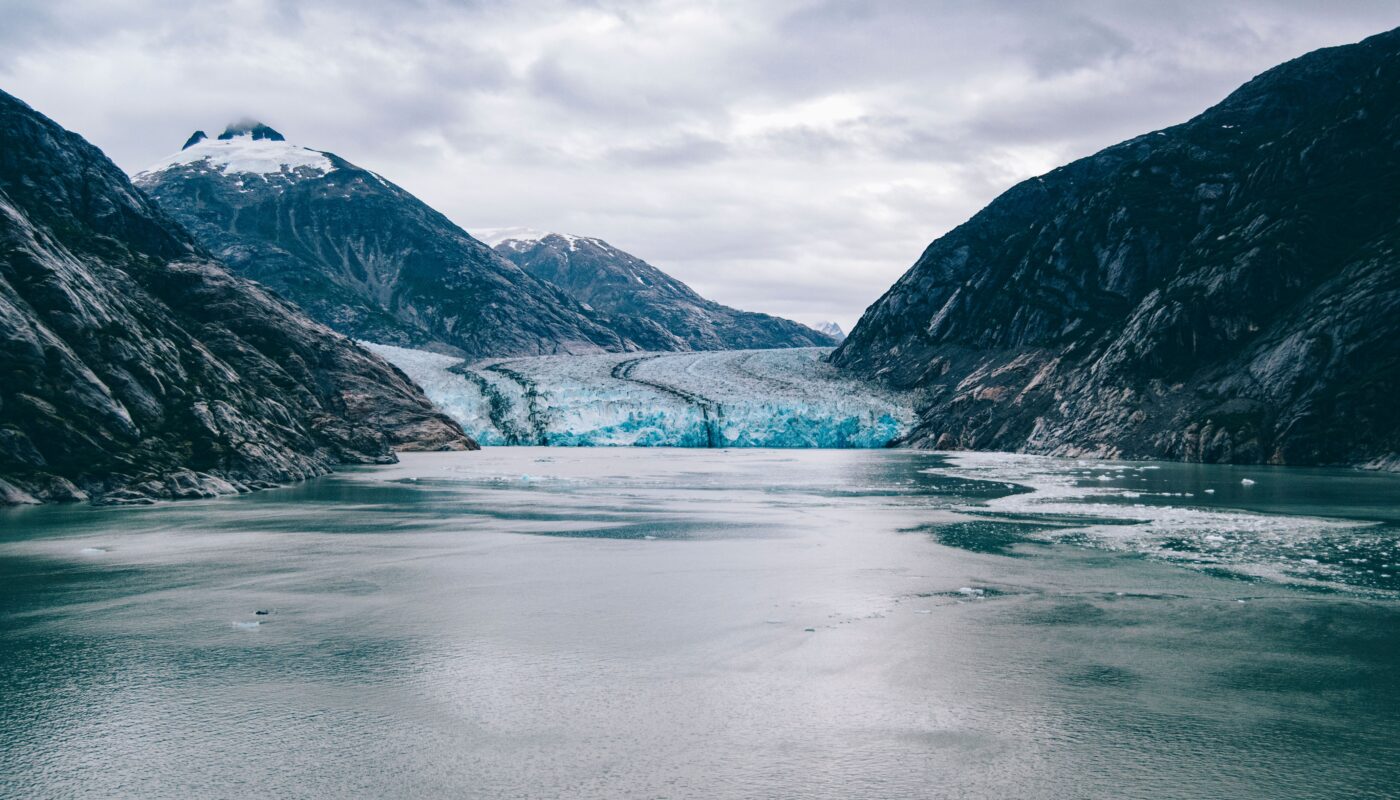
In the mountains outside Juneau, Alaska, a huge tongue of ice stretches down from the Juneau Icefield toward Mendenhall Lake. This is Mendenhall Glacier, one of the most recognizable natural landmarks in Southeast Alaska.
For generations, people have traveled to Juneau to see it.
Cruise passengers, photographers, hikers, families, scientists, and local residents have all been drawn to the same extraordinary landscape: a broad glacier framed by steep mountains, waterfalls tumbling from rocky slopes, forests surrounding a cold lake, and ice reflecting shades of white and blue.
But Mendenhall Glacier is no longer the same glacier that earlier generations saw.
It has been retreating and thinning, changing both its appearance and the landscape surrounding it. Recent U.S. Forest Service information notes that the glacier has retreated substantially since the end of the Little Ice Age and that its lower section has experienced major thinning in recent decades. Modeling studies also indicate that retreat is expected to continue during this century.
This transformation has given Mendenhall a special significance.
It remains a spectacular destination, but it is also a place where visitors can observe a changing climate landscape with their own eyes.
Mendenhall is therefore more than a glacier.
It is a natural laboratory, a tourism landmark, a source of freshwater, a wildlife environment, and a powerful reminder that even landscapes that appear permanent can change dramatically.
Where Is Mendenhall Glacier?
Mendenhall Glacier lies in the Mendenhall Valley near Juneau, Alaska.
Its location is one of its greatest advantages for visitors.
Many major glaciers require aircraft, boats, or demanding wilderness journeys to reach. Mendenhall, by comparison, is remarkably accessible. The U.S. Forest Service describes it as one of Alaska’s most accessible glaciers and notes that it is about 13 miles from downtown Juneau.
The glacier is part of the much larger Juneau Icefield, an extensive area of snow and ice that feeds numerous glaciers.
The Juneau Icefield is not simply a giant frozen plateau. It is a complex system from which individual glaciers flow into surrounding valleys.
Mendenhall is one of those outlet glaciers.
Its ice travels downhill under gravity, gradually moving from the higher icefield toward the lower valley.
That movement is extremely slow compared with a river of liquid water, but it is nevertheless significant.
Mendenhall Is a Moving Glacier, Not a Frozen Mountain
A glacier may look motionless from a viewing platform, but the ice is constantly responding to gravity.
Snow accumulates at high elevations.
Over many seasons, the weight of newer snow compresses older layers.
Eventually, the material becomes dense glacial ice.
Once enough ice has accumulated, gravity pulls the mass downslope.
The result is a slow-moving body of ice capable of transporting enormous amounts of rock and sediment.
The Forest Service explains that Mendenhall’s ice travels roughly 13 miles from the Juneau Icefield to Mendenhall Lake, grinding bedrock and carrying large rocks along the way.
This is one reason the surrounding landscape looks so dramatic.
The mountains and valley were not simply shaped by ordinary rainfall and rivers.
Glacial erosion played a major role.
How Glaciers Create Valleys
Glaciers are powerful landscape-forming forces.
As thick ice moves over bedrock, rocks embedded in the glacier can scrape against the ground.
The glacier can also fracture and remove pieces of rock.
Over very long periods, this erosion can deepen and widen mountain valleys.
Glacial valleys commonly have broad floors and steep sides.
Mendenhall’s surroundings reflect this history.
The glacier has helped carve and modify the valley through which it travels, leaving behind a landscape that records the movement of ice over thousands of years.
Even after the glacier retreats, its geological influence remains.
Rocks, sediments, lakes, valleys, and drainage patterns can all preserve evidence of former glacial activity.
The Juneau Icefield: Mendenhall’s Frozen Source
Mendenhall Glacier cannot be understood without looking at the Juneau Icefield above it.
The icefield acts as a vast high-altitude reservoir of snow and ice.
Snowfall accumulates there and contributes to the ice that eventually flows through outlet glaciers.
The U.S. Forest Service identifies Mendenhall as one of 38 large glaciers flowing from the approximately 1,500-square-mile Juneau Icefield.
This connection is crucial.
A glacier’s condition depends partly on what happens at its higher elevations.
If enough snow accumulates and survives year after year, the glacier receives a supply of new ice.
If melting and other forms of ice loss become greater than the amount of new accumulation, the glacier loses mass.
That imbalance can eventually cause thinning and retreat.
What Does Glacier Retreat Actually Mean?
The word retreat can sometimes be misleading.
A retreating glacier does not necessarily mean that the entire glacier has stopped moving.
Instead, the position of its lower end, known as the terminus, moves backward because ice is being lost faster than it is being replaced at the front.
Imagine a conveyor belt carrying ice toward the valley.
If ice disappears from the front faster than new ice arrives, the end of the glacier moves farther uphill.
The ice can still be flowing downhill.
This distinction is important when discussing Mendenhall.
The glacier is not simply sitting still and melting in place.
It remains part of a dynamic ice system while its overall mass and extent decline.
Mendenhall’s Long Retreat
Mendenhall Glacier’s retreat did not begin yesterday.
According to the U.S. Forest Service, the glacier has been thinning and retreating since the end of the Little Ice Age in the late eighteenth century. The agency reports that its recession accelerated during the twentieth century and that the glacier retreated more than a kilometer during the last two decades while its lower reaches thinned by as much as 150 meters.
These figures illustrate just how much the glacier can change within a human lifetime.
A person who photographed Mendenhall decades ago could record a substantially different glacier position from the one visible today.
The difference becomes particularly meaningful when old photographs are compared with modern images from the same location.
The mountains remain.
The valley remains.
But the ice occupies less of the landscape.
Why Is the Glacier Shrinking?
Several factors influence glacier size, including snowfall, temperature, melting, ice flow, and local geography.
A glacier can survive when its long-term gains and losses remain reasonably balanced.
But sustained warming can alter this balance.
Higher temperatures can increase surface melting.
Changes in precipitation can affect how much snow accumulates at high elevations.
If the glacier repeatedly loses more ice than it gains, it becomes thinner and its terminus can retreat.
Mendenhall’s retreat fits into a much larger pattern occurring across Alaska.
The U.S. Forest Service reports that glaciers throughout the Tongass region are projected to recede, with some expected to disappear entirely, and that the Juneau Icefield is projected in one cited study to lose roughly 60% of its volume and area over the next 50 years.
These projections are not a prediction of the exact date on which Mendenhall will disappear.
Rather, they demonstrate the scale of change expected across the wider icefield system.
A Glacier Can Retreat While Still Flowing
This point deserves special attention because it is frequently misunderstood.
Glacial movement and glacial retreat are not opposites.
A glacier can continue moving downhill while its terminus retreats uphill.
The important issue is the balance between incoming ice and outgoing ice.
If more ice is being lost at the lower end than is being delivered from higher elevations, the glacier becomes shorter.
This is why the phrase “the glacier is retreating” should not be interpreted as “the glacier has stopped moving.”
Mendenhall remains a dynamic glacier.
Its problem is that its ice losses have exceeded its gains over sustained periods.
Mendenhall Lake Is Part of the Glacier’s Story
The water in front of Mendenhall Glacier is not an unrelated scenic feature.
Mendenhall Lake developed as the glacier retreated.
The U.S. Forest Service notes that the lake formed in the 1930s as a result of glacier retreat.
This is a striking example of how glacial retreat can create new landscapes.
When ice withdraws from a valley, depressions left behind can fill with meltwater and precipitation.
Over time, a lake can become a permanent part of the landscape.
Visitors today may think of Mendenhall Lake and Mendenhall Glacier as two separate attractions.
Geologically, however, they are closely connected.
The lake exists in its present form largely because the glacier changed position.
A Landscape That Keeps Rebuilding Itself
When Mendenhall retreats, it exposes ground that has been covered by ice.
At first, this newly uncovered terrain can look harsh and almost lifeless.
But nature quickly begins to work.
Mosses and lichens can colonize exposed surfaces.
Then grasses, shrubs, and other plants establish themselves.
Eventually, larger vegetation can develop.
The U.S. Forest Service describes this progression around Mendenhall, noting the establishment of plants such as fireweed, willow, lupine, and alder on recently exposed terrain, followed by later forest development.
This process demonstrates an important principle:
Glacier retreat does not simply remove something from the landscape; it also creates space for something new.
The new ecosystem, however, does not necessarily replace everything that was lost.
Glaciers influence water supplies, sediments, temperatures, habitats, and seasonal river behavior.
A changing glacier therefore changes the entire environmental system around it.
Water From the Glacier
Mendenhall Glacier is connected to the local freshwater system.
Its meltwater enters Mendenhall Lake, which drains into Mendenhall River.
This makes the glacier important beyond its visual appeal.
Glacial melt contributes to downstream hydrology.
As glaciers change, the timing and quantity of meltwater can also change.
The Forest Service reports that across western Juneau Icefield watersheds, maximum glacier melt has occurred earlier in recent years and that reductions in glacier volume are changing freshwater flows downstream.
These changes matter for ecosystems, fish, vegetation, and people.
Glaciers are therefore part of a larger water cycle connecting mountains with rivers and eventually the sea.
Wildlife Around Mendenhall
Mendenhall’s importance extends beyond geology.
The surrounding forests, streams, wetlands, and mountains provide habitat for wildlife.
The area can offer opportunities to see birds and mammals, while salmon streams attract wildlife during spawning periods.
This makes a visit about much more than looking at ice.
Visitors can observe the interaction between:
- Glacier
- Lake
- Forest
- Streams
- Wildlife
- Mountains
The National Park Service describes Juneau’s Mendenhall area as a place where visitors can learn about wildlife and plant communities while seeing how life returns as glaciers retreat.
That ecological transition is one of the most fascinating aspects of the site.
Mendenhall and the Salmon Connection
Salmon are an important part of Southeast Alaska’s ecosystems.
Streams around the Mendenhall area provide habitat for spawning fish.
Once salmon enter freshwater, they become an important food source for other animals.
Their presence can therefore connect mountain streams with forest wildlife.
This is an excellent example of why glacier landscapes should not be viewed only through the lens of ice.
A glacier may appear to be an isolated natural attraction, but its meltwater can support rivers, and those rivers can support fish, birds, mammals, and vegetation.
The glacier is one part of a much larger ecological network.
Why Mendenhall Is So Popular With Visitors
Accessibility has made Mendenhall unusually important for tourism.
The U.S. Forest Service describes it as the most accessible glacier in the Tongass and notes that visitors can explore the shoreline of Mendenhall Lake, reach waterfalls, and follow forest trails to overlooks.
The National Park Service also highlights the Mendenhall area as a Juneau attraction where visitors can learn about glaciers, wildlife, and plant life while exploring trails.
This accessibility means that people who may never undertake a remote glacier expedition can still experience glacial scenery.
For many visitors, Mendenhall may be their first encounter with a glacier.
That makes its educational role particularly valuable.
The Famous Blue Ice
One of Mendenhall’s most recognizable visual features is its blue ice.
Glacial ice can develop intense blue tones because of the way dense ice interacts with light.
As snow is compressed over long periods, much of the air between snow grains is removed.
The resulting dense ice absorbs certain wavelengths of visible light more effectively than others.
Blue wavelengths are more likely to reach the observer.
This can create the vivid blue appearance associated with old glacial ice.
The effect is especially noticeable in cracks, walls, crevasses, and areas where dense ice is exposed.
For photographers, this can produce extraordinary images.
But the most beautiful ice is not necessarily the safest ice.
Glaciers contain hidden hazards, and visitors should follow local guidance rather than approaching unstable areas simply to obtain a closer photograph.
Waterfalls Add Another Layer to the Scene
Mendenhall’s landscape contains more than ice.
Waterfalls descend from the surrounding mountains, adding movement to a scene that might otherwise appear dominated by solid rock and frozen water.
The combination of waterfalls, glacier, lake, and forest creates the classic Mendenhall landscape.
Rain and seasonal snowmelt can increase waterfall flow.
This means the same viewpoint can look dramatically different depending on the weather.
A rainy day may produce a much more powerful waterfall scene than a dry period.
For photographers, changing weather is therefore not necessarily a disadvantage.
It can create new opportunities.
The Glacier as a Photography Time Capsule
Photographs have an unusual role at Mendenhall.
Because the glacier is retreating, photographs taken from the same location at different times can reveal changes that are difficult to appreciate during a single visit.
A single photograph shows one moment.
A collection of photographs taken over decades can show a transformation.
This makes Mendenhall an excellent example of how photography can document environmental change.
Travelers can contribute to that visual record simply by photographing the landscape responsibly and preserving the date and location of their images.
Future generations may be able to compare those photographs with the glacier they see later.
Mendenhall as a Climate Education Site
Climate change can sometimes feel distant and theoretical.
Mendenhall provides something different.
It offers a physical landscape where long-term environmental change can be observed.
The glacier’s retreat has exposed terrain, changed the relationship between ice and lake, and altered the visual appearance of the valley.
The National Park Service emphasizes that visitors to Juneau can learn about glaciers and observe how plants and wildlife respond as glaciers retreat.
This makes the area valuable not only for tourism but also for education.
Students, researchers, photographers, and travelers can all use the landscape to think about how climate affects real places.
A Changing Glacier Can Also Mean Changing Hazards
Glacier retreat does not produce only scenic and ecological changes.
It can also affect natural hazards.
The broader Juneau region has experienced glacial outburst flooding, in which large quantities of water stored near or behind glacier ice can be released rapidly.
Such events demonstrate that a changing glacier system can have direct consequences for communities.
This is an important reminder that glacier science is not merely about measuring ice.
It is also about understanding water, infrastructure, ecosystems, and human safety.
Communities near rapidly changing glaciers increasingly need monitoring systems and careful hazard planning.
Why Calling Mendenhall a “Vanishing Icon” Makes Sense
Mendenhall is sometimes described as a vanishing icon because its identity is closely tied to the glacier, while the glacier itself is becoming smaller.
There is an emotional dimension to this.
For visitors, Mendenhall may be a once-in-a-lifetime destination.
For Juneau residents, it is part of the local landscape.
For scientists, it is a valuable record of environmental change.
For future generations, however, the view may be different.
The glacier may occupy less of the valley.
The lake may dominate more of the landscape.
Vegetation may cover ground that is currently exposed rock.
The familiar image of Mendenhall may therefore become a historical reference.
That does not mean the entire landscape will disappear.
Quite the opposite.
A new landscape is already developing.
Will Mendenhall Glacier Completely Disappear?
It is tempting to ask for a precise year when the glacier will vanish.
But glaciers are complicated systems, and such a date cannot be stated with certainty based simply on current retreat.
Future glacier behavior will depend on climate conditions, snowfall, temperature, ice dynamics, and local geography.
What can be said with much greater confidence is that continued warming is expected to cause further glacier loss across the Juneau Icefield.
The U.S. Forest Service cites modeling that projects substantial future reductions in Juneau Icefield ice volume and area.
Therefore, the more useful question may not be:
“What year will Mendenhall disappear?”
A better question is:
“How will Mendenhall and the surrounding ecosystem continue to change?”
That question captures the complexity of the future.
What Visitors Should Remember
A trip to Mendenhall Glacier is an opportunity to see a natural environment in transition.
Visitors should treat the area with care.
Stay on designated trails where appropriate.
Follow current safety instructions.
Keep away from unstable glacier ice and dangerous water.
Respect wildlife.
Avoid disturbing plants or geological features.
And remember that the glacier is not merely a scenic background.
It is part of an interconnected system involving mountains, snow, ice, freshwater, forests, wildlife, and people.
The more visitors understand this connection, the more meaningful the experience becomes.
The Future Landscape of Mendenhall
Imagine visiting the Mendenhall Valley far in the future.
The mountains may look familiar.
The river may still flow through the valley.
Forests may be thicker.
New vegetation may cover land that is currently bare.
Mendenhall Lake may occupy a more prominent place in the scene.
And the glacier itself may be considerably smaller.
This thought experiment shows why glacier retreat matters.
The disappearance of ice does not mean the disappearance of the landscape.
Instead, it means the landscape enters another chapter.
Glacial valleys can become forests.
Ice-covered depressions can become lakes.
Meltwater can become rivers.
Exposed sediments can become soil.
Life continues.
But the original glacier cannot simply be replaced.
That is what makes its retreat significant.
Final Thoughts
Mendenhall Glacier is one of Alaska’s most accessible and recognizable glaciers, but its importance goes far beyond tourism.
It is a moving body of ice connected to the enormous Juneau Icefield. It has carved and shaped the valley, contributed to the development of Mendenhall Lake, supplied meltwater to the local drainage system, and helped create habitats used by plants and wildlife.
Today, it is also an unmistakable example of a changing glacier.
Its long-term retreat has exposed new ground and transformed the landscape. Vegetation is colonizing former glacier surfaces, waterways are changing, and the relationship between the glacier and Mendenhall Lake continues to evolve.
For travelers, this makes Mendenhall especially meaningful.
A visit is not simply an opportunity to photograph blue ice.
It is a chance to witness a landscape in motion across a much longer timescale.
The glacier may appear still, but its story is constantly unfolding.
Every year of retreat reveals another part of the valley.
Every new plant growing on exposed ground represents another stage of ecological succession.
Every photograph taken today becomes a record of what this landscape looked like at a particular moment.
Mendenhall Glacier may eventually become smaller, but the story it tells will not disappear with the ice.
Its valley, lake, rivers, forests, wildlife, and exposed rock will continue to carry evidence of the glacier that shaped them.
That is why Mendenhall deserves to be remembered not simply as a beautiful glacier, but as a living chapter in the environmental history of Alaska.