 by
Few glaciers in the world have attracted as much scientific and public attention as Thwaites Glacier, a vast and rapidly changing glacier in West Antarctica. It is often called the “Doomsday Glacier,” a dramatic nickname that has appeared in headlines around the world.
But what does that name actually mean?
Is Thwaites Glacier about to collapse overnight? Could it suddenly cause catastrophic flooding around the world? Or is the reality more complex than the nickname suggests?
The truth is both serious and more nuanced.
Thwaites is one of the most unstable and important glaciers on Earth because of its enormous size, its rapid changes, and its potential influence on the wider West Antarctic Ice Sheet. Scientists do not expect the entire glacier to disappear suddenly in the next few years. However, research indicates that it is likely to continue retreating and that its long-term loss could contribute substantially to global sea-level rise. Its weakening could also affect neighboring glaciers and the stability of a much larger section of West Antarctica.
Understanding Thwaites means looking beyond the frightening nickname and examining the science behind one of the planet’s most closely studied ice systems.
Where Is Thwaites Glacier?
Thwaites Glacier is located in West Antarctica, where it flows toward Pine Island Bay in the Amundsen Sea.
It is enormous.
The glacier and its drainage basin cover roughly 192,000 square kilometers, an area often compared with the size of Great Britain or the U.S. state of Florida. Thwaites is also approximately 120 kilometers wide, making it one of the widest glaciers on Earth.
From a satellite image, Antarctica can appear to be one giant frozen continent. However, the ice sheet is actually made up of many different glacier systems, ice streams, floating ice shelves, and drainage basins.
Thwaites is particularly important because it acts as a major pathway through which ice from the interior of West Antarctica can flow toward the ocean.
Scientists are therefore interested in more than the glacier itself.
They are also concerned about what could happen to the wider ice sheet behind it.
Why Is It Called the “Doomsday Glacier”?
The nickname “Doomsday Glacier” is not an official scientific name.
It is a media label designed to describe the potentially serious consequences of major ice loss from Thwaites.
The concern comes from two main factors.
First, Thwaites contains enough ice to make a significant contribution to global sea-level rise if it were eventually lost. Estimates commonly place its potential direct contribution at around 65 centimeters, or roughly two feet, although this would occur over a long period rather than all at once.
Second, Thwaites plays an important stabilizing role within the West Antarctic Ice Sheet.
The glacier and its associated floating ice shelves help slow the movement of inland ice toward the ocean. If this stabilizing influence weakens significantly, ice farther inland could flow more rapidly toward the sea.
This is why scientists sometimes describe Thwaites as a critical part of the West Antarctic system.
The danger is not that the glacier will suddenly explode or disappear tomorrow.
The real concern is that continued retreat could trigger long-lasting changes that would be difficult, or in some cases impossible, to reverse on human timescales.
How Does Thwaites Glacier Normally Work?
To understand why Thwaites is vulnerable, it helps to understand how a glacier interacts with land and ocean.
At higher elevations, snow falls and gradually becomes compressed into ice.
Over time, this ice flows downhill under its own enormous weight.
Eventually, the glacier reaches the coast.
At some point, the ice is no longer resting on the bedrock beneath it. Instead, it begins to float on seawater.
The transition between grounded ice and floating ice is called the grounding line.
This is one of the most important locations in the entire Thwaites system.
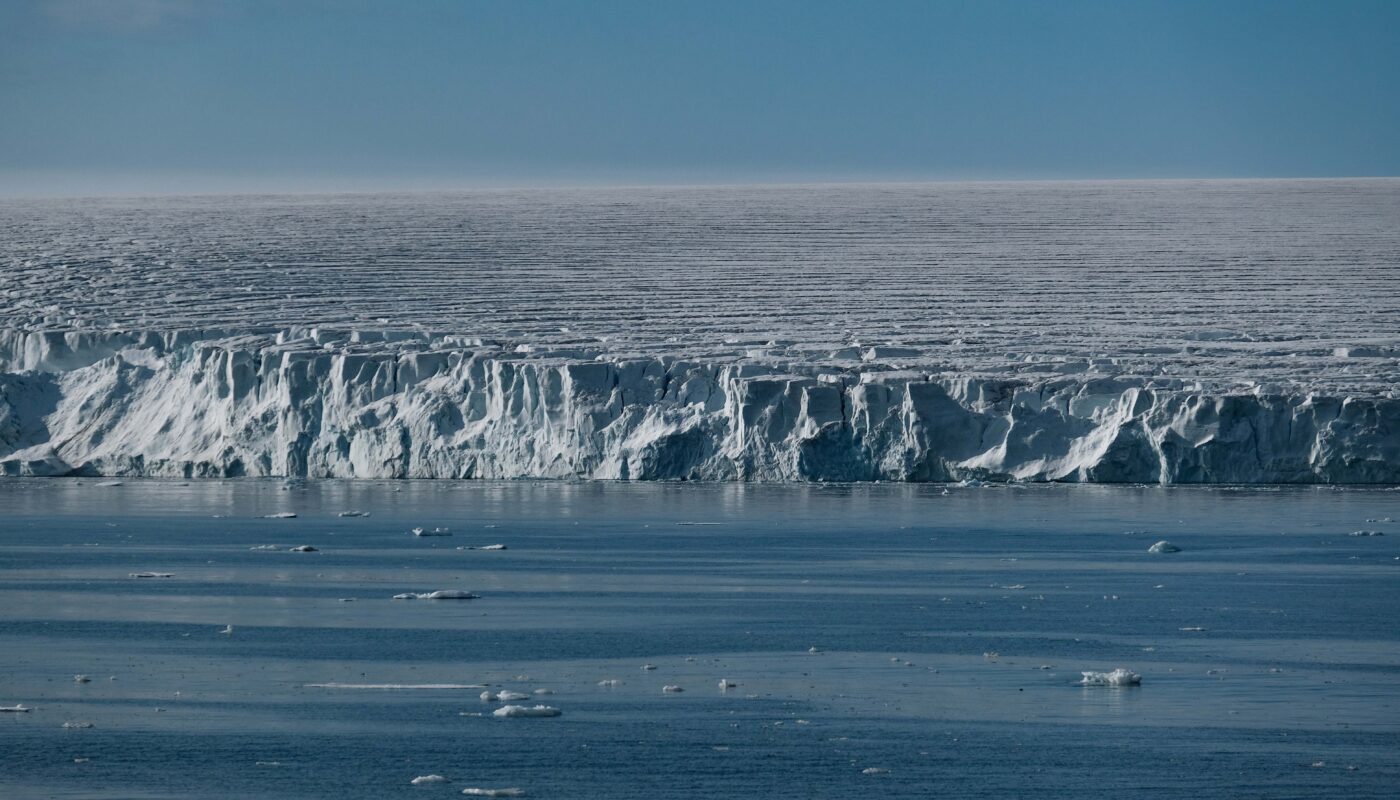
Beyond the grounding line, floating ice shelves extend over the ocean. These ice shelves act somewhat like a brake, slowing the movement of the glacier behind them.
Scientists refer to this restraining effect as buttressing.
If an ice shelf becomes thinner, fractures, or breaks apart, the grounded glacier behind it can accelerate.
This matters because grounded land ice contributes to sea-level rise when it flows into the ocean. Floating ice already displaces water, so the melting of an existing floating ice shelf does not directly raise sea level in the same way. However, losing that shelf can remove an important barrier that slows the flow of land-based ice.
Thwaites’ vulnerability is therefore closely connected to what is happening both above and below the ice.
The Role of Warm Ocean Water
One of the biggest threats to Thwaites comes from the ocean.
Water does not need to be extremely hot to melt Antarctic ice.
Seawater that is only a few degrees above the freezing point can still contain enough heat to melt large amounts of ice over time.
Scientists studying Thwaites have found that relatively warm water from the surrounding ocean can move onto the continental shelf and beneath floating sections of the glacier. This water can reach the grounding zone and melt ice from below.
This process is particularly important because much of the bedrock beneath Thwaites lies below sea level.
As the grounding line retreats inland, warm ocean water may gain access to deeper parts of the glacier.
That can create a dangerous feedback process.
The sequence may look like this:
- Warm ocean water reaches the underside of floating ice.
- The ice shelf melts and becomes thinner.
- The glacier loses some of its buttressing.
- Ice flow accelerates.
- The grounding line retreats inland.
- More ocean water can reach vulnerable areas.
- Further melting and retreat become possible.
This feedback is one reason Thwaites has become such an important subject of scientific research.
What Is Marine Ice Sheet Instability?
Thwaites is often discussed in connection with a process called marine ice sheet instability.
This concept is especially relevant to glaciers resting on bedrock that lies below sea level.
Imagine a glacier sitting in a basin where the bedrock becomes deeper farther inland.
As the grounding line retreats, the glacier may move into deeper water.
Deeper water can allow the ice at the grounding line to become thicker. Thicker ice can potentially flow faster, delivering more ice toward the ocean.
That faster flow can encourage further retreat.
This creates a feedback loop.
Scientists are still working to determine exactly how quickly such processes could unfold at Thwaites and how different stabilizing factors might influence the outcome.
The important point is that instability does not mean instant collapse.
It describes a process that can continue and intensify over decades, centuries, or longer.
Recent modeling also suggests that some natural feedbacks, including changes in the solid Earth beneath Antarctica as ice is removed, may slow retreat compared with simpler scenarios. However, these processes do not remove the fundamental risk of long-term ice loss.
Is Thwaites Glacier Already Changing?
Yes.
Thwaites has experienced major changes over recent decades.
The International Thwaites Glacier Collaboration reports that the glacier’s retreat has accelerated considerably during the past 40 years. The amount of ice flowing out of the broader Thwaites region has also increased dramatically compared with previous decades.
Satellite observations have shown significant changes to the glacier’s floating ice structures.
NASA has documented how Thwaites’ ice tongue and surrounding floating ice changed and fractured over time, with the glacier becoming increasingly broken and exposed to ocean-driven melting.
The glacier is also already contributing to global sea-level rise.
Research organizations associated with the Thwaites project estimate that it currently accounts for roughly four percent of annual global sea-level rise.
That may sound like a small percentage, but it is significant for a single glacier system.
And the concern is not limited to what Thwaites is contributing today.
Scientists are trying to understand what its future behavior could mean for sea level over generations.
What Happens Beneath the Glacier?
One of the most fascinating aspects of Thwaites research is that much of the most important activity is hidden beneath kilometers of ice.
Scientists cannot simply walk underneath the glacier and observe what is happening.
Instead, they use a combination of:
- Satellite observations
- Aircraft surveys
- Radar measurements
- Ocean instruments
- Autonomous underwater vehicles
- Drilling
- GPS measurements
- Computer models
- Marine sediment records
The International Thwaites Glacier Collaboration was created to bring together scientists studying these different parts of the system.
Between 2018 and 2025, researchers from the United States, United Kingdom, and several other countries investigated the glacier and its surrounding environment. The broader collaboration continues through 2026 as research findings and analysis are completed.
The scientists are trying to answer two fundamental questions:
How much could Thwaites contribute to sea-level rise?
And:
How quickly could major changes occur?
Those questions sound simple, but answering them requires understanding an extremely complicated interaction between ice, rock, seawater, atmosphere, and climate.
A Hidden Threat: Seawater Can Move Beneath Grounded Ice
Recent research has added another layer of complexity to the Thwaites story.
Scientists have documented seawater intrusions beneath areas of grounded ice near the glacier’s grounding zone.
Using satellite radar observations, researchers found evidence that seawater can move inland beneath grounded sections of Thwaites under certain conditions. These intrusions can expose ice to ocean water and make it more vulnerable to melting.
Another study published in 2025 examined the drainage of a subglacial lake beneath Thwaites.
The sudden release of water beneath the ice produced a buoyant plume that temporarily increased the melting rate beneath the ice shelf, illustrating how hidden water systems beneath Antarctica can influence glacier stability.
These discoveries show why predicting Thwaites is so difficult.
The glacier is not simply melting from sunlight or warm air.
Its future is influenced by processes occurring beneath the ice and below the ocean surface.
Could Thwaites Collapse Suddenly?
This is where the word “Doomsday” can create misunderstanding.
Current scientific assessments do not suggest that the entire glacier will suddenly collapse into the ocean within the next few years.
The International Thwaites Glacier Collaboration states that a complete collapse is unlikely in the next few decades. However, its findings indicate that the glacier is expected to continue retreating and that retreat could accelerate through the 21st and 22nd centuries. The possibility of broader instability in parts of the West Antarctic Ice Sheet over that longer period cannot be ruled out.
This is an important distinction.
The threat is not necessarily a Hollywood-style disaster happening on a single day.
The greater concern is persistent, long-term change.
Even a relatively gradual process can be enormously important.
Sea level does not need to rise by several meters overnight to create serious consequences. A steady increase can worsen coastal flooding, storm surges, erosion, saltwater intrusion, and damage to infrastructure.
The longer-term nature of the threat should not make it seem less important.
In fact, it gives societies an opportunity to plan, adapt, and reduce future risks.
How Much Could Sea Level Rise?
Thwaites alone contains enough ice to contribute approximately 65 centimeters of global sea-level rise if its ice were eventually lost.
But the potential consequences extend beyond Thwaites itself.
The glacier is part of the West Antarctic Ice Sheet, a much larger ice system.
If major retreat in this region weakened the natural barriers holding back inland ice, neighboring glaciers could also accelerate.
The International Thwaites Glacier Collaboration notes that the entire West Antarctic Ice Sheet contains enough ice to raise global sea level by several meters if it were lost completely, although such a process would unfold over very long timescales rather than immediately.
This is why scientists often focus on Thwaites as a potential gateway to larger changes.
Its importance is not just about the glacier itself.
It is also about what may happen to the ice behind and around it.
Why Does Sea-Level Rise Matter So Much?
A rise in global average sea level affects coastal communities in different ways.
The impact depends on local geography, land subsidence, tides, storms, and existing infrastructure.
Potential consequences include:
- More frequent coastal flooding
- Stronger storm-surge impacts
- Erosion of beaches and coastlines
- Saltwater entering freshwater systems
- Damage to roads, homes, and infrastructure
- Increased pressure to build expensive coastal defenses
- Displacement of vulnerable communities
Even relatively small increases in average sea level can significantly increase the frequency of flooding during high tides and storms.
It is also important to remember that sea-level rise is not identical everywhere.
Ocean circulation, gravitational effects, land movement, and other regional factors can cause local sea levels to change differently from the global average.
So, the loss of Antarctic ice would have consequences far beyond Antarctica itself.
Why Is Predicting Thwaites So Difficult?
Scientists cannot simply measure today’s melt rate and multiply it into the future.
Glaciers are dynamic systems.
The rate of change can accelerate, slow down, or vary because of many interacting factors.
Important uncertainties include:
- How much warm water will reach the glacier
- How ocean circulation may change
- How quickly ice shelves will weaken
- How the grounding line will respond
- How fractures and calving will develop
- How snowfall patterns will change
- How the bedrock beneath the ice responds
- How neighboring glaciers may react
Scientists use computer models to explore different possible futures.
But models must include complex physical processes, and some of these processes are still being studied.
That is why research at Thwaites remains so important.
The goal is not to predict one exact date when a collapse will happen.
Instead, scientists are working to narrow the range of possible outcomes and understand which conditions could speed up or slow down the glacier’s retreat.
Is There Any Hope?
Yes—but “hope” should not be confused with a guarantee that Thwaites will remain unchanged.
Research suggests that the future behavior of the glacier is not entirely predetermined on short and medium timescales.
The rate of global warming and the amount of future ocean warming can influence how quickly vulnerable ice systems change.
The International Thwaites Glacier Collaboration emphasizes that immediate and sustained reductions in greenhouse gas emissions offer the best chance of slowing ice loss and reducing the risk of initiating similar unstable retreat in other vulnerable Antarctic regions.
There are also natural stabilizing processes that scientists are continuing to study.
For example, as ice mass is removed, the Earth’s crust beneath Antarctica can gradually rebound upward. Modeling suggests that this can influence the movement of the grounding line and potentially slow ice loss in some circumstances.
However, these mechanisms are not a reason for complacency.
They are part of a complicated system that scientists are still working to understand.
What Have Scientists Learned So Far?
The major lesson from Thwaites research is that the glacier is both highly vulnerable and highly complex.
Scientists have learned that:
- Warm ocean water plays a major role in melting the glacier from below.
- Floating ice shelves help slow the flow of inland ice.
- Thwaites has experienced major retreat and structural changes.
- Processes at the grounding line are critical to its future.
- Seawater can interact with grounded ice in unexpected ways.
- Hidden subglacial water systems can influence melting.
- Natural feedbacks may sometimes slow retreat.
- Major uncertainty remains about the exact pace of future change.
The research has therefore made the picture clearer, but it has also revealed new questions.
That is how science often progresses.
The more closely scientists observe a system, the more they discover about its complexity.
The “Doomsday Glacier” Nickname: Helpful or Harmful?
The nickname has certainly attracted attention.
Without it, many people might never have heard of Thwaites Glacier.
The term communicates that the glacier matters.
However, it can also create unnecessary confusion.
“Doomsday” may suggest that disaster is immediate and unavoidable.
That is not what the science says.
A more accurate interpretation is that Thwaites represents a serious long-term climate and sea-level risk.
Its future matters enormously, but there is still uncertainty about the speed and exact path of its retreat.
The challenge is to take the science seriously without exaggerating it.
Thwaites does not need an overnight collapse to become one of the most important climate stories of our time.
Its gradual transformation could still affect coastlines and communities for generations.
Conclusion
Thwaites Glacier is called the “Doomsday Glacier” because of its potential importance—not because scientists expect it to vanish overnight.
Located in West Antarctica, this enormous glacier is already changing rapidly and is one of the most significant contributors to sea-level rise from the Antarctic Ice Sheet. Its vulnerability comes largely from warm ocean water melting ice from below, the weakening of floating ice shelves, and the possibility that retreat could expose deeper and more unstable parts of the glacier.
If Thwaites were eventually lost, it could contribute roughly 65 centimeters to global sea-level rise. More importantly, its retreat could influence the stability of surrounding parts of the West Antarctic Ice Sheet.
Yet the future is not as simple as the word “doomsday” suggests.
A complete collapse is not expected within the next few decades, and scientists continue to study processes that could either accelerate or slow future retreat.
What makes Thwaites so important is not that it offers one simple prediction.
It is that it represents a major test of how Earth’s ice sheets respond to a warming world.
The glacier’s future will depend on a complex interaction between ocean temperatures, atmospheric conditions, ice dynamics, and long-term climate change.
For scientists, Thwaites is a vast natural laboratory.
For coastal communities, it is a warning that changes taking place in one of the most remote places on Earth can eventually affect people thousands of kilometers away.
And for the rest of the world, the story of Thwaites Glacier is a reminder that Antarctica may feel distant—but the consequences of its changing ice are global.